What Is Broken Link Building?
The strategy begins with a problem on someone else’s page, but the broken link does not create an entitlement to a backlink. The publisher owns the source and should replace the link only when the proposed resource fits the current context and improves the reader’s experience.
Broken link building is different from repairing a backlink that already pointed to your site. In this workflow, the original dead destination can belong to any website, and your replacement is a new candidate citation.
- Find a live relevant source page
- Verify that an outbound destination is dead
- Understand what the source expected
- Provide a genuinely equivalent resource
- Let the publisher make the editorial decision
| Element | Required evidence | Why it matters |
|---|---|---|
| Source page | Live relevant document | Defines audience and context |
| Dead link | Observed href and failed destination | Confirms the problem |
| Replacement | Current useful resource | Provides a credible option |
| Outreach | Exact source and citation context | Makes review efficient |
Broken link building works only when the dead citation, replacement resource and source-page context align.
How Does Broken Link Building Work?
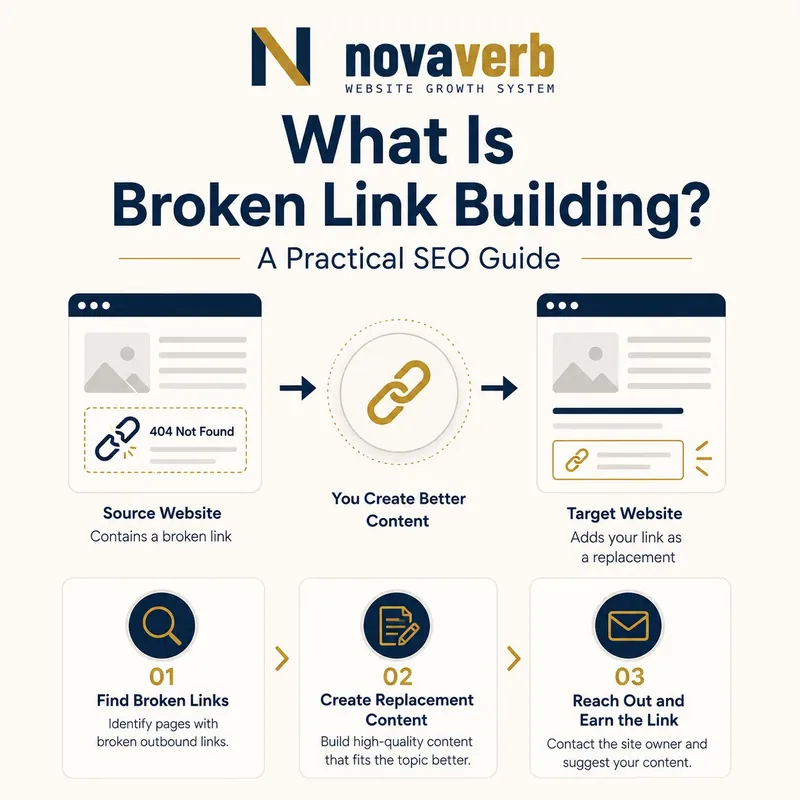
First, identify pages in a relevant topic where outbound links no longer resolve to useful content. Next, read the surrounding sentence and any archived description to understand the original resource type. A replacement guide, dataset or tool should satisfy that same task without copying the retired work.
After outreach, track outcomes honestly: corrected to your page, corrected to another source, removed, declined or no response. Only a live link to your resource counts as acquired.
- Define a topic and target audience
- Discover relevant resource pages
- Resolve outbound links and flag dead targets
- Qualify source and citation context
- Create or choose the replacement
- Send precise outreach
- Verify the publisher’s live update
| Stage | Question | Output |
|---|---|---|
| Discovery | Where are relevant dead citations? | Candidate queue |
| Verification | Is the link truly dead now? | Confirmed opportunity |
| Fit | What did the original citation promise? | Replacement requirements |
| Outreach | Does the request help editorial review? | Publisher decision |
| Verification | What changed on the live source? | Recorded outcome |
The workflow should narrow a large crawl into a small set of verified, contextually strong opportunities.
Broken Link Building vs Backlink Reclamation
Reclamation starts with a historical or current connection to your property. Broken link building starts with a dead third-party destination and a relevant external source that has not necessarily linked to you before.
Read What Is Backlink Reclamation? for the repair workflow involving lost, broken, misdirected or unlinked relationships tied to your own property.
- Identify who owned the original destination
- Preserve historical evidence for reclamation
- Treat replacement outreach as a new editorial request
- Report recovered and newly acquired links separately
| Dimension | Broken link building | Backlink reclamation |
|---|---|---|
| Prior link to your site | Not required | Usually present or implied |
| Starting evidence | Dead third-party citation | Existing or historical relationship |
| Primary request | Consider a new replacement | Restore or correct a relationship |
| Reporting | New acquired link | Recovered link |
Do not relabel new-link outreach as reclamation simply because the original external citation was broken.
How Do You Find Broken Link Building Opportunities?
Start with topical hubs, curated resource pages, maintained guides and pages linking to retired assets in your market. Avoid scanning unrelated websites only because they have high provider metrics. Relevance and editorial fit determine whether the opportunity deserves review.
Use a crawl or link-checking tool for discovery, then open the live source and destination. A single transient server error is not enough; confirm persistent failures before outreach.
- Choose one specific topic
- Find pages that curate or cite resources
- Extract external destinations
- Resolve statuses and redirects
- Group pages sharing the same dead target
- Read the live citation context
- Score replacement fit
| Discovery source | Useful when | Qualification risk |
|---|---|---|
| Resource page | It actively curates relevant references | May be outdated throughout |
| Topical guide | The dead citation supports a specific claim | Replacement may need narrow scope |
| Competitor backlink export | It reveals retired linked assets | Provider rows still need live checks |
| Site crawl | You have a defined relevant domain set | Large crawls can create noise |
Discovery is successful when it finds a verified editorial need, not merely a large number of 404 URLs.
How Do You Qualify a Broken Link Opportunity?
Read the sentence before and after the link. Determine whether the citation supported a definition, statistic, tool, example or deeper guide. The replacement should perform the same job at equal or better depth while remaining accurate and accessible.
Inspect whether the source is maintained, whether the page has a real audience and whether the link was editorial rather than injected by a shared widget. This protects the team from spending time on sources that cannot produce a useful relationship.
- Source and topic match
- Live editorial context
- Persistent destination failure
- Replacement type and scope match
- Legitimate publisher and page
- Clear reader benefit
| Signal | Qualified pattern | Disqualifying pattern |
|---|---|---|
| Relevance | Same topic and audience | Unrelated source |
| Placement | Editorial citation in useful copy | Spam, comments or injected widget |
| Failure | Confirmed dead final destination | Temporary or working URL |
| Replacement | Equivalent purpose and depth | Generic homepage |
| Publisher | Maintained legitimate property | Abandoned or manipulative site |
A qualified opportunity combines a real failure with a source and replacement that make sense to the same reader.
What Makes a Good Replacement Resource?
Use the anchor, surrounding text and available historical description to define the resource requirements. If the source cited a dataset, a general blog post is not equivalent. If it cited a step-by-step tutorial, a sales page does not complete the task.
Build for the reader before writing outreach. Include clear definitions, evidence boundaries, examples, useful tables and direct next steps. Avoid copying archived content or making claims you cannot support.
- Matches the original citation purpose
- Provides current accurate information
- Offers distinctive usefulness
- Uses a stable crawlable URL
- Has clear authorship and maintenance ownership
- Avoids premature sales pressure
| Dead resource type | Suitable replacement | Weak replacement |
|---|---|---|
| Definition guide | Complete current definition | Thin glossary sentence |
| Research dataset | Transparent current dataset | Opinion article |
| Calculator or checker | Working tool with clear limits | Product homepage |
| How-to tutorial | Tested step-by-step guide | Generic category page |
| Reference list | Maintained curated resource | Unrelated lead form |
The replacement earns consideration by completing the original reader task, not by targeting the same keyword alone.
How Do You Write Broken Link Outreach?
Do not hide automation behind fake familiarity or claim that a link is owed. A useful message lets an editor reproduce the problem quickly, compare the replacement and decide whether to update, remove or choose another source.
Personalize only with facts you verified. If multiple pages share one dead template link, contact the appropriate owner once rather than sending duplicate messages.
- Address the appropriate page owner
- Name the exact URL and dead reference
- State the observed final failure
- Offer one matching resource
- Explain how it serves the current passage
- Close without pressure or repeated demands
| Outreach element | Include | Avoid |
|---|---|---|
| Subject | Specific page or broken resource | Manufactured urgency |
| Evidence | Exact dead destination | Unverified claims |
| Replacement | One relevant URL | Long list of your pages |
| Value | Current reader benefit | Ranking promises |
| Follow-up | One reasonable reminder | Repeated automated sequences |
Good outreach reduces the editor’s verification work while leaving the editorial decision entirely with them.
How Do You Measure Broken Link Building?
Separate operational conversion from SEO outcomes. A live acquired link is a campaign result; rankings, traffic and conversions are downstream observations with many possible causes and should be measured independently.
Track replacement-resource cost and maintenance responsibility as well. A campaign is not efficient if it creates many pages that win no links or become outdated shortly after publication.
- Dead links checked
- Failures verified
- Opportunities qualified
- Publishers contacted
- Replies and decisions
- Live links acquired
- Referral visits when observed
- Content creation and maintenance cost
| Metric | Definition | Denominator |
|---|---|---|
| Verification rate | Confirmed dead citations | Candidates checked |
| Qualification rate | Opportunities with strong fit | Failures verified |
| Reply rate | Publisher replies | Outreach delivered |
| Acquisition rate | Live links to replacement | Qualified outreach |
| Referral outcome | Visits through acquired links | Live acquired links |
A credible report shows the full funnel from checked candidates to verified live links, not just the wins.
Frequently Asked Questions About Broken Link Building
- Verify every failure
- Match the original resource purpose
- Respect editorial choice
Is broken link building still effective?
Is broken link building spam?
Do I need to recreate the deleted page?
Can I use a homepage as the replacement?
How many times should I follow up?
Does a 404 always create an opportunity?
Is this the same as fixing my broken backlinks?
Which tools help with the workflow?
Broken link building is defensible when verification, resource quality and publisher choice remain central.
Build Links by Solving a Verified Publishing Problem
Use the free backlink checker to explore link relationships, then manage recurring research in Backlinks Explorer and connect resulting work through the SEO tools system.
- Discover relevant sources
- Verify the dead destination
- Qualify the editorial context
- Build a useful replacement
- Track the live publisher decision
The strongest broken link campaign wins attention by improving a real page for a real reader.