What Is Education Q&A Schema?
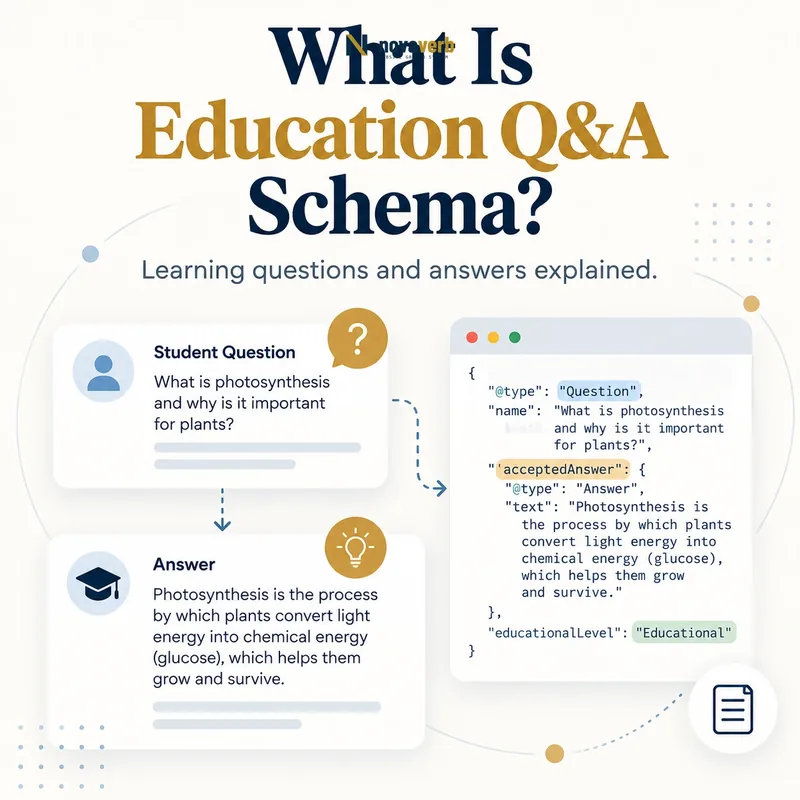
Education Q&A Schema is structured data for educational flashcard pages, using a Quiz with nested Question and Answer objects to identify visible learning prompts and answers.
The supported model is narrower than a generic question page. A Quiz represents one or more flashcards about a subject, and each Question nested through hasPart must describe a visible prompt with one accepted answer. The fixed eduQuestionType value identifies the item as a flashcard. Eligible content may appear in education-focused Q&A experiences across Search, Assistant and Lens, but correct markup does not guarantee selection, traffic or a click-through increase. The practical goal is to make accurate learning content easier to classify while preserving a useful on-page study experience. Publishers should treat pedagogy, factual accuracy and crawlability as primary requirements rather than adding schema to thin question inventories.
- Identify the exact page, asset, entity or relationship described in this section.
- Inspect the live implementation and retain the observed evidence.
- Compare the observation with the intended meaning and its primary specification.
- Correct any mismatch, then retest the live result.
- Record the accountable owner and review date.
| Entity | Purpose | Example |
|---|---|---|
| Quiz | Groups related flashcards | Cell transport set |
| hasPart | Nests each prompt | Array of Question |
| Question | Contains visible prompt | What is osmosis? |
| eduQuestionType | Declares flashcard format | Flashcard |
| acceptedAnswer | Nests the correct answer | Answer object |
| Answer.text | Provides full response | Movement of water |
- Use educational flashcards only.
- Keep every prompt visible.
- Supply one related correct answer.
- Avoid promising a rich result.
Primary specification: Google Search education Q&A structured data documentation.
Education Q&A Schema works only when a real flashcard experience and its machine-readable Quiz model describe the same accurate learning material.
Who Is Eligible for Education Q&A Rich Results?
Educational flashcard leaf pages with at least one visible question-and-answer pair are eligible when they meet technical, content and structured-data requirements.
The experience applies to education-related topics and supports English in all regions where the search feature is available, making it relevant to US publishers. Spanish availability is narrower, while Portuguese and Vietnamese have their own documented coverage. Eligibility belongs to the most detailed page containing the actual flashcards, not to a category page that merely links to question sets. Crawlers must be able to access the page and immediately encounter the questions in rendered content; a PDF or hidden data feed alone is insufficient. Quality matters across the collection because materially inaccurate educational content can affect eligibility beyond one URL. A valid parser result proves formatting, not educational correctness or feature selection.
- The exact page, asset, entity or relationship covered by this section
- The live implementation rather than an editor-only preview
- The primary specification or first-party record defining the expected behavior
- The validation result, accountable owner and review date
| Requirement | Eligible pattern | Ineligible pattern |
|---|---|---|
| Page purpose | Educational flashcards | Generic article |
| Page depth | Detailed leaf page | Empty category page |
| Visible content | Questions and answers rendered | Data file only |
| Question count | One or more flashcards | No questions |
| Language/region | Supported combination | Unsupported combination |
| Access | Crawlable indexable page | Login or noindex block |
- Confirm educational intent.
- Choose the leaf page.
- Verify visible content.
- Check language and crawlability.
Eligibility begins with a crawlable, detailed educational page whose visible flashcards are accurate and useful before any schema is added.
Which Properties Does Education Q&A Schema Require?
The required model uses Quiz.hasPart for each Question, and every Question requires text, eduQuestionType set to Flashcard and one acceptedAnswer containing Answer.text.
At the root, @type: Quiz establishes the learning set. The hasPart property can contain one Question or an array of several related Questions. Each prompt needs its full visible wording in text; abbreviated schema that omits conditions or qualifiers can change the answer. The eduQuestionType value is case-sensitive in implementation practice and must be Flashcard for this feature. Exactly one acceptedAnswer belongs to each Question, and its nested Answer must contain the full response text. Recommended about and educationalAlignment properties add subject and curriculum context but cannot substitute for missing required fields.
- Identify the exact page, asset, entity or relationship described in this section.
- Inspect the live implementation and retain the observed evidence.
- Compare the observation with the intended meaning and its primary specification.
- Correct any mismatch, then retest the live result.
- Record the accountable owner and review date.
| Property | Object | Requirement |
|---|---|---|
| hasPart | Quiz | Required Question nesting |
| text | Question | Full prompt required |
| eduQuestionType | Question | Flashcard required |
| acceptedAnswer | Question | Exactly one accepted answer |
| @type | acceptedAnswer | Answer |
| text | Answer | Full answer required |
- Nest Questions under hasPart.
- Use the exact Flashcard value.
- Include complete prompt text.
- Include one complete accepted answer.
A valid core object fully represents every visible prompt and its one accepted answer without relying on recommended context to hide missing essentials.
How Is Education Q&A Different From QAPage?
Education Q&A models one or more authored flashcards in a Quiz, while QAPage models one primary question followed by answers in a user-answer context.
The two formats share Question and Answer vocabulary but apply different page rules and property sets. A flashcard collection uses Quiz, repeats hasPart and fixes eduQuestionType to Flashcard. A conventional QAPage Schema centers on exactly one main Question and typically allows people to submit answers, with answer counts and accepted or suggested responses. An education page containing a single user-submitted homework question followed by answers may fit QAPage rather than Quiz. A publisher-written FAQ fits neither merely because it contains question headings. Choosing by visible page behavior prevents double-marking the same text with incompatible semantics and makes validation results easier to interpret.
- The exact page, asset, entity or relationship covered by this section
- The live implementation rather than an editor-only preview
- The primary specification or first-party record defining the expected behavior
- The validation result, accountable owner and review date
| Dimension | Education Q&A | QAPage |
|---|---|---|
| Root type | Quiz | QAPage |
| Page focus | One or more flashcards | One primary question |
| Answer pattern | One accepted answer each | Accepted/suggested user answers |
| Key nesting | hasPart | mainEntity |
| Fixed property | eduQuestionType: Flashcard | No flashcard requirement |
| Typical authoring | Learning publisher | Community or user question |
- Count primary questions.
- Identify who authors answers.
- Map the correct root type.
- Remove conflicting markup.
Choose the schema from the page’s real interaction and authorship model, not from the superficial presence of question marks.
What Content Should a Flashcard Page Show?
A flashcard page should immediately show accurate educational prompts and answers that match the full text represented in its structured data.
Interaction can reveal or flip an answer, but the material must exist in the rendered page rather than only in an external file. A learner should understand the subject, the scope of the set and how to move between cards. Each prompt should be specific enough to have one defensible accepted answer; ambiguous wording weakens both learning value and markup accuracy. Explanations can extend beyond the short answer when they clarify reasoning, units or common misconceptions, yet the acceptedAnswer text should still answer the exact prompt. Avoid mass-produced near-duplicate cards, promotional interstitials and answers that require an image the learner cannot access. Accessibility controls, keyboard behavior and readable focus states also matter to the real experience even though schema validation does not test them.
- Identify the exact page, asset, entity or relationship described in this section.
- Inspect the live implementation and retain the observed evidence.
- Compare the observation with the intended meaning and its primary specification.
- Correct any mismatch, then retest the live result.
- Record the accountable owner and review date.
| Content element | Good pattern | Risky pattern |
|---|---|---|
| Prompt | Complete and specific | Fragment without context |
| Answer | Direct and accurate | Unrelated keyword text |
| Explanation | Supports reasoning | Promotional filler |
| Visibility | Rendered on page | Remote file only |
| Interaction | Accessible reveal | Mouse-only hidden card |
| Set context | Clear subject label | Mixed unrelated topics |
- Write unambiguous prompts.
- Answer the complete question.
- Provide accessible interactions.
- Review educational accuracy.
The visible flashcard experience should teach effectively on its own, with structured data serving as an exact description rather than a replacement.
How Does Educational Alignment Work?
Educational alignment adds optional subject, grade or standards context through AlignmentObject entries with alignmentType and targetName.
A Quiz can use educationalAlignment to describe its field of study and its target level or standard. For a subject, set alignmentType to educationalSubject and use a recognizable targetName such as Biology. For a grade or standard, use educationalLevel and identify the relevant level or established framework node. Multiple AlignmentObject entries can express both dimensions. The value should reflect a real curriculum mapping reviewed by someone qualified to make it, not a list of search keywords. If a publisher cannot support a precise standards claim, a truthful broad subject is better than fabricated specificity. Store framework identifiers and labels centrally so template changes do not create inconsistent names across thousands of quiz pages.
- The exact page, asset, entity or relationship covered by this section
- The live implementation rather than an editor-only preview
- The primary specification or first-party record defining the expected behavior
- The validation result, accountable owner and review date
| Alignment goal | alignmentType | targetName example |
|---|---|---|
| Subject | educationalSubject | Biology |
| Domain | educationalSubject | Algebra |
| Grade | educationalLevel | Fifth grade |
| Standard | educationalLevel | Grade 7: Cell Structure |
| Multiple contexts | Separate objects | Subject plus level |
| Unknown mapping | Omit | Do not invent |
- Identify the real subject.
- Confirm grade or standard.
- Create separate AlignmentObjects.
- Audit labels for consistency.
Educational alignment is valuable only when every label represents a defensible curriculum relationship maintained as source data.
How Do You Write Education Q&A JSON-LD?
Write Education Q&A JSON-LD as a Quiz whose hasPart array contains complete Question objects, each with Flashcard type and one nested accepted Answer.
Place the object in an application/ld+json script and serialize it with a trusted encoder. Use @context: https://schema.org, then add recommended about or alignment only when the source data is reliable. Generate each Question from the same record that renders the visible flashcard, preserving punctuation, mathematical notation and qualifiers. Do not concatenate raw user input into JSON because quotes, line breaks or markup can corrupt the payload. When the page also carries Breadcrumb Schema or WebSite Schema, a coherent graph can hold the entities without changing the Quiz requirements. Validate the rendered output, not an isolated code sample that never passes through the production template.
- Identify the exact page, asset, entity or relationship described in this section.
- Inspect the live implementation and retain the observed evidence.
- Compare the observation with the intended meaning and its primary specification.
- Correct any mismatch, then retest the live result.
- Record the accountable owner and review date.
| JSON-LD field | Expected value | Source |
|---|---|---|
| @context | https://schema.org | Constant |
| @type | Quiz | Constant |
| about.name | Learning concept | Quiz record |
| hasPart | Question array | Flashcard records |
| Question.text | Full prompt | Visible card |
| acceptedAnswer.text | Full answer | Reviewed answer |
- Use a JSON serializer.
- Generate from visible records.
- Preserve full wording.
- Test production rendering.
Reliable JSON-LD is a safe serialization of the same reviewed records shown to learners, with no parallel content source that can drift.
What Education Q&A Schema Mistakes Are Common?
Common mistakes include using Quiz on non-flashcard pages, omitting the Flashcard value, hiding questions, supplying several accepted answers and marking inaccurate content.
Teams sometimes confuse any quiz interface with the supported flashcard model, even when it contains multiple-choice tests, polls or graded assessments. Other failures include placing markup on category pages, nesting Question incorrectly, abbreviating the prompt, returning an answer that is merely related rather than correct, and adding two acceptedAnswer objects to one card. Client-side applications may emit empty arrays before data loads or prevent crawlers from seeing the interactive content. A rich-result test can catch structural errors but not determine whether a chemistry answer is scientifically accurate. Collection-wide quality review, rendering tests and content ownership are therefore necessary. Remove markup from ineligible templates instead of forcing their data into a vocabulary that misstates the learning experience.
- The exact page, asset, entity or relationship covered by this section
- The live implementation rather than an editor-only preview
- The primary specification or first-party record defining the expected behavior
- The validation result, accountable owner and review date
| Mistake | Why it fails | Fix |
|---|---|---|
| Generic quiz marked Flashcard | Wrong experience | Use only real flashcards |
| Missing eduQuestionType | Required value absent | Set exact Flashcard value |
| Two accepted answers | Ambiguous required model | Choose one correct answer |
| Hidden question data | Not visible to learners | Render content on page |
| Category page markup | Not detailed leaf page | Move to card set |
| Inaccurate answer | Quality violation | Expert review and correct |
- Remove ineligible markup.
- Correct required properties.
- Review answer accuracy.
- Retest rendered templates.
The highest-risk errors misrepresent page type or educational truth, so fix them before optional metadata and cosmetic warnings.