
What Is HTTP/2?
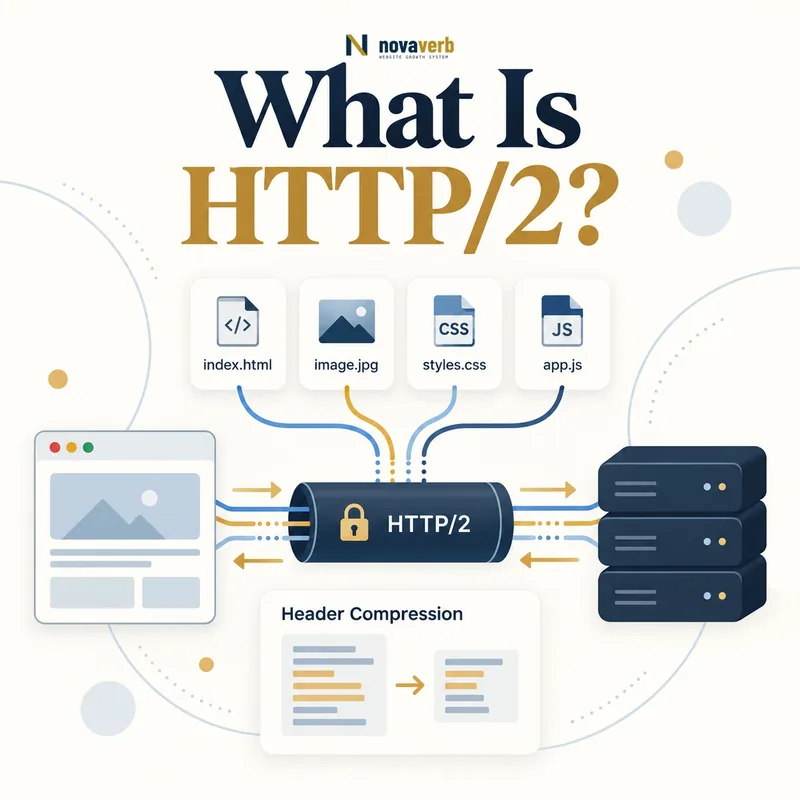
Web browsers use HTTP to request HTML, CSS, JavaScript, images, fonts and data. HTTP/2 keeps the familiar methods, status codes, URLs and headers while changing how messages travel between client and server. Its framing layer divides messages into smaller frames that can be interleaved on a shared connection.
This design reduces the need to open many parallel connections to the same origin and can use network capacity more efficiently. HTTP/2 is a delivery improvement, not a content or ranking system. A page can negotiate HTTP/2 and still be slow because its server, rendering, images or JavaScript create the real bottleneck.
- Identify the exact page, asset, entity or relationship described in this section.
- Inspect the live implementation and retain the observed evidence.
- Compare the observation with the intended meaning and its primary specification.
- Correct any mismatch, then retest the live result.
- Record the accountable owner and review date.
| Term | Meaning | Practical effect |
|---|---|---|
| Connection | Transport path to an origin | Carries many streams |
| Stream | Independent request-response exchange | Allows concurrent work |
| Frame | Small binary protocol unit | Can be interleaved |
| Multiplexing | Multiple active streams together | Reduces connection competition |
| Header compression | Compact repeated metadata | Cuts repeated header bytes |
- HTTP/2 changes transport behavior, not page meaning.
- It commonly operates over encrypted HTTPS in browsers.
- Real benefit depends on the full delivery path.
Primary specification: RFC 9113: HTTP/2.
HTTP/2 modernizes how web messages share a connection while preserving the meaning of standard HTTP requests and responses.
How Does HTTP/2 Work?
For HTTPS, the browser and server commonly negotiate the protocol during the TLS setup using ALPN. Once HTTP/2 is selected, each request belongs to a numbered stream. Frames from different streams share the connection, and the receiver reassembles them into complete HTTP messages.
Flow control limits how much data can be in flight for a connection or stream. Priority signals can express delivery preferences, although real server and browser behavior varies. A transport-level packet loss can still delay traffic sharing the TCP connection, so HTTP/2 removes application-layer blocking between responses but cannot remove every network constraint.
- The exact page, asset, entity or relationship covered by this section
- The live implementation rather than an editor-only preview
- The primary specification or first-party record defining the expected behavior
- The validation result, accountable owner and review date
| Stage | Protocol action | Outcome |
|---|---|---|
| TLS setup | ALPN advertises support | HTTP/2 or fallback selected |
| Request creation | Assign a stream ID | Independent exchange begins |
| Framing | Split messages into frames | Interleaving becomes possible |
| Flow control | Manage sender windows | Prevents uncontrolled buffering |
| Response assembly | Rebuild headers and body | Browser receives normal resource |
- The browser connects securely.
- Client and server negotiate HTTP/2.
- Requests open streams on the connection.
- Frames travel and responses are reconstructed.
The core flow is negotiate one connection, create independent streams, exchange frames and rebuild ordinary HTTP messages.
HTTP/2 vs HTTP/1.1 and HTTP/3
HTTP/1.1 can reuse connections but generally processes responses serially within each one, so browsers historically opened several connections per origin. HTTP/2 reduces that need through multiplexing and header compression. Many old front-end patterns - domain sharding, excessive concatenation and tiny inline assets - were shaped by HTTP/1.1 constraints.
HTTP/3 uses QUIC over UDP and handles streams without one lost packet delaying unrelated streams at the transport layer. It can also improve reconnection behavior. Supporting HTTP/3 does not make HTTP/2 obsolete; delivery stacks normally negotiate the best mutually supported protocol and keep fallbacks for clients or networks that cannot use QUIC.
- Identify the exact page, asset, entity or relationship described in this section.
- Inspect the live implementation and retain the observed evidence.
- Compare the observation with the intended meaning and its primary specification.
- Correct any mismatch, then retest the live result.
- Record the accountable owner and review date.
| Dimension | HTTP/1.1 | HTTP/2 | HTTP/3 |
|---|---|---|---|
| Transport | TCP | TCP | QUIC over UDP |
| Parallel requests | Several connections commonly used | Multiplexed streams | Independent QUIC streams |
| Header compression | No protocol-wide compact format | HPACK | QPACK |
| Loss behavior | Connection-level TCP | Shared TCP connection | Stream-aware QUIC handling |
| Fallback role | Legacy baseline | Broad modern baseline | Newer optimized option |
- Keep fallbacks working.
- Remove legacy optimizations only after measurement.
- Compare protocol use in real traffic.
Treat HTTP versions as negotiated delivery options and measure each on the networks and regions your audience actually uses.
What HTTP/2 Features Affect Page Speed?
Multiplexing lets a browser request several resources without waiting for one response to finish before another begins. HPACK reduces repeated header fields across messages, which matters more when cookies and metadata are large. Fewer connections can reduce repeated TLS and congestion setup, especially on higher-latency networks.
These advantages have limits. One large download can still compete for bandwidth, a congested origin can delay every stream and poor prioritization can deliver low-value resources ahead of critical CSS or images. Server Push was once promoted as a key feature but proved difficult to use efficiently and should not be the foundation of a current optimization plan.
- The exact page, asset, entity or relationship covered by this section
- The live implementation rather than an editor-only preview
- The primary specification or first-party record defining the expected behavior
- The validation result, accountable owner and review date
| Feature | Potential benefit | Limitation |
|---|---|---|
| Multiplexing | Concurrent resource progress | Shared connection still has finite capacity |
| HPACK | Smaller repeated headers | Large cookies remain costly |
| Connection reuse | Less setup overhead | Cross-origin resources need other connections |
| Flow control | Balances transmission | Poor windows can throttle delivery |
| Prioritization | Signals important resources | Implementation behavior varies |
| Server Push | Proactive response delivery | Can waste bandwidth and is not a safe default |
- Identify critical page resources.
- Measure their request start and completion order.
- Inspect connection reuse and protocol.
- Fix page-level bottlenecks before tuning edge cases.
HTTP/2 improves connection efficiency, but resource order, server capacity and page architecture still determine when useful content appears.
How Can HTTP/2 Help SEO?
A busy page with many same-origin resources may complete network work sooner when streams share one connection. This can help CSS, JavaScript, fonts and images arrive with less connection overhead. The benefit may be more visible for mobile users and visitors far from the origin, but it varies with CDN coverage, network quality and cache state.
HTTP/2 is not a substitute for strong content, crawlable navigation or correct canonical signals. Assess it with Time to First Byte, First Contentful Paint, Largest Contentful Paint and Interaction to Next Paint. Separate protocol improvements from changes caused by caching or asset optimization.
- Identify the exact page, asset, entity or relationship described in this section.
- Inspect the live implementation and retain the observed evidence.
- Compare the observation with the intended meaning and its primary specification.
- Correct any mismatch, then retest the live result.
- Record the accountable owner and review date.
| SEO-related outcome | How HTTP/2 may contribute | What else to verify |
|---|---|---|
| Faster first view | Less connection overhead | Origin response and critical path |
| Faster repeat navigation | Efficient shared asset requests | Browser caching policy |
| Mobile experience | Better use of limited connections | CPU and JavaScript work |
| Regional reliability | Modern CDN delivery | Edge coverage and errors |
| Crawl access | Stable protocol negotiation | Status, robots and content parity |
- Measure production pages, not protocol labels alone.
- Segment results by device and geography.
- Confirm crawlers receive equivalent content and status.
HTTP/2 contributes to SEO only through measurable delivery and experience improvements on otherwise useful, accessible pages.
What HTTP/2 SEO Problems Can Occur?
A CDN may advertise HTTP/2 while connecting to the origin over another protocol; that is not inherently wrong, but it means end-to-end behavior differs from the browser-facing label. Misconfigured TLS, ALPN or cipher support can force fallback or failed connections. Proxies can alter headers, redirects, compression and status codes unexpectedly.
Domain sharding spreads assets across hosts and can create extra DNS, TLS and connection setup that HTTP/2 was designed to reduce. Bundling every script into one large file may delay useful code and weaken caching granularity. Large cookies repeat across requests, even when header compression reduces incremental bytes, and can add privacy or cache variation problems.
- The exact page, asset, entity or relationship covered by this section
- The live implementation rather than an editor-only preview
- The primary specification or first-party record defining the expected behavior
- The validation result, accountable owner and review date
| Problem | Symptom | First control |
|---|---|---|
| Negotiation failure | Fallback or connection error | Check TLS and ALPN by region |
| Proxy mismatch | Wrong status, header or body | Compare edge and origin |
| Domain sharding | Many setup phases remain | Consolidate safe same-origin assets |
| Oversized bundle | Critical code arrives late | Use measured code splitting |
| Large cookies | Repeated request overhead | Reduce scope and size |
| Protocol-specific outage | One client group fails | Keep fallback and monitor versions |
- Check negotiated protocol on public URLs.
- Compare status, headers and bodies.
- Review host count and request waterfall.
- Test fallback and regional behavior.
The main risk is treating HTTP/2 enablement as proof of correct delivery without comparing the actual public response and page waterfall.
Should You Still Bundle and Concatenate Files?
One enormous bundle may avoid requests but forces users to download and parse code they do not need. A small change can invalidate the whole file. Too many tiny files create scheduling, header and processing overhead. The practical middle ground is a limited number of purpose-built chunks with stable shared dependencies and route-specific code.
CSS should also follow rendering needs. Critical styles can arrive early, while noncritical styles should not block initial content. Images remain separate resources and need appropriate formats, dimensions and priority. Review code splitting, render-blocking resources and Gzip compression as parts of the same delivery system.
- Identify the exact page, asset, entity or relationship described in this section.
- Inspect the live implementation and retain the observed evidence.
- Compare the observation with the intended meaning and its primary specification.
- Correct any mismatch, then retest the live result.
- Record the accountable owner and review date.
| Strategy | Advantage | Tradeoff |
|---|---|---|
| Single large bundle | Few requests | Poor granularity and unused code |
| Many tiny files | Fine caching boundaries | Scheduling and processing overhead |
| Route chunks | Downloads match navigation | Build complexity |
| Stable vendor chunk | Reusable shared code | Can grow without discipline |
| Critical CSS split | Early rendering support | Requires accurate extraction |
| Inline everything | No separate request | Larger HTML and weak caching |
- Split by user journey and change frequency.
- Keep the initial critical path small.
- Measure download, parse and execution together.
HTTP/2 removes the need for extreme concatenation but does not make resource count, size or scheduling irrelevant.
How Do You Audit HTTP/2?
Test the homepage, important landing pages, application routes, static assets, redirects, errors and third-party hosts. Record the negotiated protocol, connection reuse, DNS and TLS timing, request start order, status, headers and transferred bytes. A page may use HTTP/2 for its HTML but load major third-party resources over other connections.
Compare cold and warm navigation, mobile and desktop networks, and at least the most valuable audience regions. Confirm that HTTP/1.1 fallback returns equivalent content. If HTTP/3 is available, measure it separately rather than grouping every modern protocol together. Use field evidence to decide whether infrastructure tuning matters more than image, script or server work.
- The exact page, asset, entity or relationship covered by this section
- The live implementation rather than an editor-only preview
- The primary specification or first-party record defining the expected behavior
- The validation result, accountable owner and review date
| Audit check | Evidence | Pass condition |
|---|---|---|
| Negotiation | Browser or command-line protocol output | HTTP/2 selected where intended |
| Connection reuse | Network connection IDs | Same-origin requests share efficiently |
| Response parity | Status, headers and body hashes | Content equivalent across protocols |
| Waterfall | Request timing and order | Critical resources progress appropriately |
| Fallback | Forced HTTP/1.1 request | Page remains available |
| Regional test | Multiple edge locations | Consistent negotiation and content |
| Field result | Real-user performance segments | Benefit matches target audience |
- Select representative URLs and regions.
- Capture protocol and response evidence.
- Inspect the resource waterfall.
- Test fallbacks and content parity.
- Prioritize the largest verified bottleneck.
An HTTP/2 audit succeeds when negotiation is reliable, responses are equivalent and the waterfall shows a measurable delivery benefit without hidden regressions.