
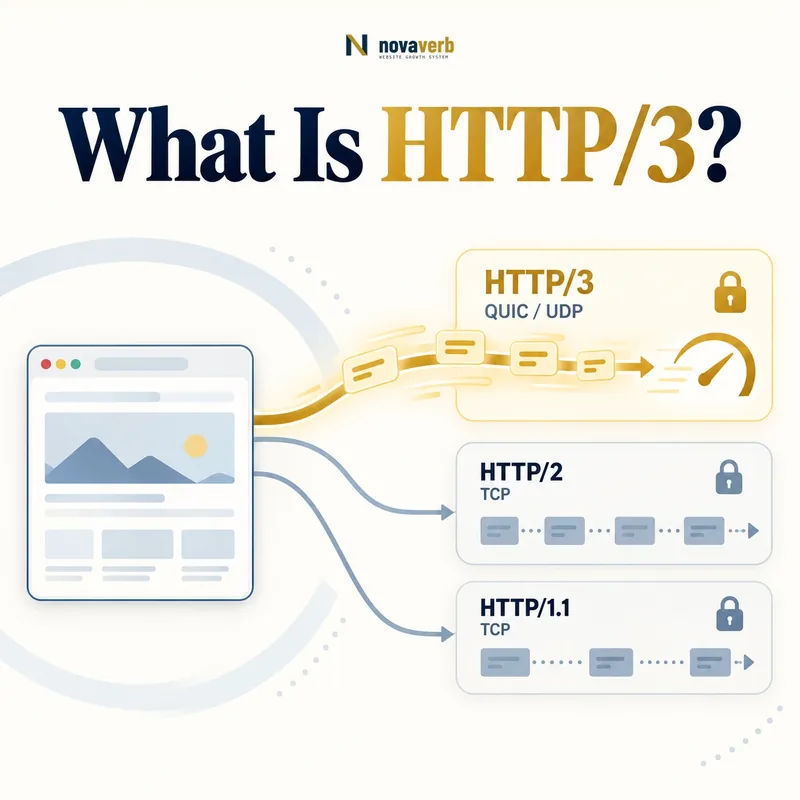
What Is HTTP/3?
QUIC runs over UDP and integrates encryption, connection management, congestion control and multiplexed streams. HTTP/3 maps each request-response exchange to a QUIC stream and uses its own framing layer. A visitor still requests the same HTML, CSS, JavaScript, image or API URL; the difference is how those messages move across the network.
The design can reduce connection setup overhead and prevent a lost packet for one stream from stopping unrelated streams. That makes HTTP/3 relevant to mobile and variable networks, but the protocol is not a ranking mechanism. Its value must be proven through faster, more reliable delivery of useful pages.
- Identify the exact page, asset, entity or relationship described in this section.
- Inspect the live implementation and retain the observed evidence.
- Compare the observation with the intended meaning and its primary specification.
- Correct any mismatch, then retest the live result.
- Record the accountable owner and review date.
| Term | Meaning | Practical effect |
|---|---|---|
| HTTP/3 | HTTP semantics over QUIC | Modern web delivery option |
| QUIC | Secure multiplexed transport over UDP | Owns connections and streams |
| Stream | Independent ordered byte flow | One request-response exchange |
| QPACK | HTTP/3 field compression | Reduces repeated header bytes |
| Fallback | Alternative negotiated protocol | Keeps access when QUIC is unavailable |
- HTTP/3 changes transport, not page content.
- Encryption is integrated into QUIC.
- Fallback remains part of a safe deployment.
Primary specification: RFC 9114: HTTP/3.
HTTP/3 keeps ordinary HTTP meaning while moving delivery onto QUIC for stream-aware transport and modern connection behavior.
How Does HTTP/3 Work?
A client can learn about an HTTP/3 endpoint through an alternative-service signal or other discovery mechanism. It then performs QUIC connection establishment and application-protocol negotiation. Requests use bidirectional streams, while control and QPACK state use dedicated unidirectional streams.
Each request stream carries headers and data frames. QUIC provides reliable, ordered delivery within that stream plus flow control at the stream and connection levels. Because independent streams do not share TCP’s ordered byte sequence, loss affecting one stream does not automatically stop progress on the others. Network congestion still affects the connection as a whole.
- The exact page, asset, entity or relationship covered by this section
- The live implementation rather than an editor-only preview
- The primary specification or first-party record defining the expected behavior
- The validation result, accountable owner and review date
| Stage | HTTP/3 or QUIC action | Outcome |
|---|---|---|
| Discovery | Client learns endpoint support | Can attempt HTTP/3 |
| Connection | QUIC and TLS state established | Secure transport becomes ready |
| Stream creation | Request gets a stream | Independent exchange begins |
| Framing | HEADERS and DATA travel | HTTP message is represented |
| Recovery | Lost data retransmitted per stream | Other streams can progress |
| Reuse | Connection serves more requests | Less repeated setup |
- The client discovers HTTP/3 availability.
- A QUIC connection is established.
- Requests open independent streams.
- Frames travel and responses are reconstructed.
The working flow is discover, connect securely, open streams, exchange frames and retain a reliable fallback path.
HTTP/3 vs HTTP/2 and HTTP/1.1
HTTP/1.1 commonly uses several TCP connections to achieve parallelism. HTTP/2 introduced binary framing, multiplexing and HPACK while keeping TCP underneath. That improves application-layer concurrency, yet lost or reordered TCP data can delay every active HTTP/2 stream until the byte sequence is repaired.
HTTP/3 moves multiplexing into QUIC and uses QPACK for header fields. QUIC can also support connection migration when a device changes networks. HTTP versions should coexist through negotiation: clients that cannot reach QUIC over UDP still need dependable HTTP/2 or HTTP/1.1 service.
- Identify the exact page, asset, entity or relationship described in this section.
- Inspect the live implementation and retain the observed evidence.
- Compare the observation with the intended meaning and its primary specification.
- Correct any mismatch, then retest the live result.
- Record the accountable owner and review date.
| Dimension | HTTP/1.1 | HTTP/2 | HTTP/3 |
|---|---|---|---|
| Transport | TCP | TCP | QUIC over UDP |
| Multiplexing | Not built in | HTTP streams over TCP | QUIC streams |
| Field compression | No shared protocol mechanism | HPACK | QPACK |
| Loss scope | TCP connection | All streams can wait on TCP | Affected stream can recover independently |
| Secure setup | TLS layered separately | TLS over TCP | TLS integrated with QUIC |
| Migration | New connection normally needed | New TCP connection | QUIC connection IDs can support migration |
- Measure all negotiated versions separately.
- Keep content and status equivalent.
- Expect different results across networks.
HTTP/3 extends modern HTTP delivery rather than eliminating the need for tested HTTP/2 and HTTP/1.1 fallbacks.
What HTTP/3 Features Affect Page Speed?
Connection setup can require fewer sequential exchanges than a fresh TCP plus TLS path. Independent streams are useful on lossy networks because an image packet loss need not pause an unrelated stylesheet stream. Reusing a connection avoids repeated setup, and migration can preserve a session when a phone moves between Wi-Fi and cellular connectivity.
The gains are contextual. A warm browser cache may transfer little, a nearby HTTP/2 edge may already be fast, and a slow origin can dominate every protocol. QUIC encryption and packet processing also consume resources. Compare page milestones, error rates and tail latency rather than focusing only on handshake timing.
- The exact page, asset, entity or relationship covered by this section
- The live implementation rather than an editor-only preview
- The primary specification or first-party record defining the expected behavior
- The validation result, accountable owner and review date
| Feature | Possible benefit | Limitation |
|---|---|---|
| Reduced setup exchanges | Faster first connection | Existing sessions may already be warm |
| Independent streams | Less cross-resource blocking after loss | Bandwidth remains shared |
| Multiplexing | Concurrent same-origin requests | Poor scheduling can still hurt |
| Connection migration | Continuity across network change | Implementation and policy vary |
| QPACK | Smaller repeated fields | Large cookies remain costly |
| QUIC recovery | Transport tuned in user space | CPU and network support matter |
- Segment cold and warm visits.
- Measure stable and lossy networks.
- Compare median and slow-tail results.
- Relate gains to real page milestones.
HTTP/3 matters most where connection setup, packet loss or network changes are material parts of the user’s delay.
How Can HTTP/3 Help SEO?
Faster connection establishment may help initial HTML or critical assets begin sooner. Stream-aware loss recovery can keep important resources moving during packet loss. A stable connection through a network change may reduce failed navigation. These outcomes can support user experience, but they depend on CDN reach, protocol adoption and page architecture.
Assess HTTP/3 with Time to First Byte, First Contentful Paint, Largest Contentful Paint and Interaction to Next Paint. Correct crawl access, content quality, canonical signals and internal links remain separate requirements.
- Identify the exact page, asset, entity or relationship described in this section.
- Inspect the live implementation and retain the observed evidence.
- Compare the observation with the intended meaning and its primary specification.
- Correct any mismatch, then retest the live result.
- Record the accountable owner and review date.
| Possible outcome | HTTP/3 contribution | Evidence needed |
|---|---|---|
| Faster first visit | Lower connection setup cost | Cold-navigation timing |
| Better lossy-network load | Independent stream recovery | Packet-loss test and field tail |
| Mobile continuity | Connection migration support | Network-switch session tests |
| Global delivery | CDN edge protocol support | Regional negotiation data |
| Reliable crawl response | Protocol fallback and parity | Status and body comparison |
- Segment by device, country and network.
- Compare protocol cohorts cautiously.
- Confirm identical crawlable content.
HTTP/3 supports search outcomes only when measured delivery improvements reach important users without changing page correctness.
What HTTP/3 SEO Problems Can Occur?
Some networks restrict UDP traffic. A client should fall back quickly, but poor timeouts can delay the page before HTTP/2 begins. An outdated alternative-service advertisement can point clients toward an unavailable endpoint. Firewall, load balancer and CDN policies can allow HTTP/2 while mishandling QUIC traffic.
Protocol-specific edge code may return a different status, redirect, header or body. Bot controls can also behave differently on another delivery path. Dashboards that aggregate every protocol can hide a small but valuable user segment with high failures. Test real content parity and errors rather than assuming successful negotiation proves success.
- The exact page, asset, entity or relationship covered by this section
- The live implementation rather than an editor-only preview
- The primary specification or first-party record defining the expected behavior
- The validation result, accountable owner and review date
| Problem | Visible symptom | Control |
|---|---|---|
| UDP blocked | Delayed or failed first request | Fast tested fallback |
| Stale Alt-Svc | Repeated failed HTTP/3 attempts | Correct lifetime and endpoint health |
| Edge mismatch | Different status or content | Protocol parity tests |
| Firewall gap | Regional QUIC failure | Review UDP and load-balancer path |
| Bot policy difference | Challenge or block response | Compare legitimate automated access |
| Hidden cohort error | Aggregate metrics look healthy | Segment by protocol and region |
- Force HTTP/3 and fallback requests.
- Compare public responses byte and header-wise.
- Test restricted UDP networks.
- Segment errors by protocol and geography.
The primary operational risk is a slow or inconsistent fallback path that affects only certain networks, regions or clients.
How Do CDNs Deploy HTTP/3?
This split can deliver QUIC benefits to visitors without changing the application server. The CDN advertises HTTP/3 support, manages certificates and QUIC connections, then retrieves or caches content according to its upstream configuration. The origin still controls response generation, while the edge controls the public transport.
Enablement should include UDP reachability, certificate coverage, alternative-service behavior, cache parity, security controls and logs. One dashboard switch may not apply to every hostname or region. Connect the review to CDN delivery, HTTP/2, browser caching and Gzip compression.
- Identify the exact page, asset, entity or relationship described in this section.
- Inspect the live implementation and retain the observed evidence.
- Compare the observation with the intended meaning and its primary specification.
- Correct any mismatch, then retest the live result.
- Record the accountable owner and review date.
| Connection segment | Possible protocol | Owner to inspect |
|---|---|---|
| Browser to CDN edge | HTTP/3, HTTP/2 or HTTP/1.1 | CDN and client negotiation |
| CDN edge to origin | HTTP/2 or HTTP/1.1 commonly | CDN upstream configuration |
| Edge cache hit | Public protocol only | CDN cache and transport |
| Edge cache miss | Public plus upstream path | CDN and origin |
| Third-party request | Provider-specific protocol | Third-party host |
- Inspect every important hostname.
- Separate edge and origin protocols.
- Verify cache and security parity.
A CDN HTTP/3 rollout is successful when public QUIC delivery is reliable while origin communication and fallback remain transparent and correct.
How Do You Audit HTTP/3?
Choose important HTML templates, redirects, error pages, static assets and APIs. Record protocol, DNS, connection timing, status, headers, body hash, cache status and total resource timing. Force HTTP/3 where possible, then force HTTP/2 or HTTP/1.1 for a parity comparison.
Test first and repeat connections, because session reuse can change setup cost. Add controlled latency and packet loss, plus a network that blocks UDP. Verify that fallback begins quickly and returns equivalent content. Review field metrics segmented by protocol without treating faster-protocol users as a randomized experiment; their devices and networks may differ.
- The exact page, asset, entity or relationship covered by this section
- The live implementation rather than an editor-only preview
- The primary specification or first-party record defining the expected behavior
- The validation result, accountable owner and review date
| Audit check | Evidence | Pass condition |
|---|---|---|
| Discovery | Alt-Svc or endpoint signal | Healthy endpoint advertised intentionally |
| Negotiation | Client protocol output | HTTP/3 selected on supported path |
| Response parity | Status, headers and body | Equivalent public result |
| Loss test | Controlled packet loss | Unrelated streams continue effectively |
| UDP block | Restricted network request | Fast successful fallback |
| Regional test | Multiple CDN edges | Consistent availability |
| Field segment | Protocol-level real-user data | No hidden reliability regression |
- Select representative URLs and regions.
- Capture discovery and negotiation.
- Compare protocol responses.
- Test packet loss and UDP blocking.
- Prioritize verified reliability or speed gaps.
An HTTP/3 audit passes when discovery, negotiation, response parity, fallback and measured user outcomes all behave as intended.