
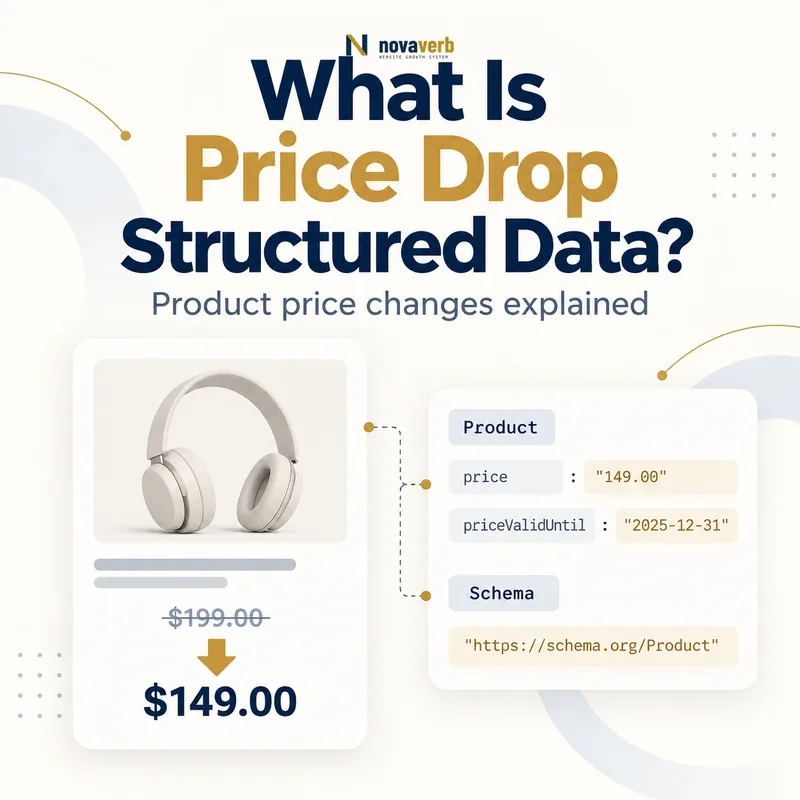
What Is Price Drop Structured Data?
Price drop structured data is not a separate Schema.org type; it is a product-result enhancement derived from observed price changes on a stable Product with an Offer.
A product page publishes current price evidence through Product and Offer. Search systems may compare that evidence over time and decide whether a meaningful reduction deserves a price-drop presentation. The publisher does not set a “priceDrop” flag or claim a historical percentage inside markup. The current documentation explicitly describes price drops as computed from observed product price changes, and display is not guaranteed. Accurate identity, one stable currency context and a current visible Offer make the history interpretable. Rotating unrelated products through one URL, resetting identifiers, or switching between Offer and AggregateOffer can destroy continuity. Treat this enhancement as a possible outcome of clean commerce data, not a schema trick that manufactures discount messaging.
- Frame the decision raised by What Is Price Drop Structured Data.
- Confirm its value type and the object it describes.
- Compare the markup with visible page information.
- Correct the source data or template without inventing values.
- Validate the rendered result and monitor future changes.
| Concept | What it means | Control |
|---|---|---|
| Product | Stable item identity | Same exact item over time |
| Offer | Current transaction price | Visible active amount |
| Observed history | Price changes across crawls | Consistent URL and identity |
| Price drop | Possible result enhancement | Computed externally |
| priceDrop property | Does not exist for this use | Do not invent |
| Display | Discretionary | No guarantee |
- Use Product with Offer.
- Keep identity stable.
- Publish only current price.
- Avoid visibility promises.
Price-drop eligibility begins with stable product identity and truthful Offer history, not a special property or manually declared discount.
The decision for What Is Price Drop Structured Data should rest on live, traceable evidence and a verified follow-up check.
How Are Price Drops Calculated?
Price drops are calculated from observed changes in a product’s price over time rather than from a publisher-supplied discount percentage.
The exact internal window and threshold are not a public contract, so an SEO team should not promise that changing $100 to $99 will trigger an enhancement. Search systems need repeated evidence that the same product and offer context previously carried a higher price and now carries a lower one. That implies stable canonical URL, product identifiers, currency and seller relationship. A price that oscillates because geolocation, cookies, taxes, subscriptions or variant defaults change may not form a coherent series. Keep an internal ledger of source price, promotion, currency, variant and effective timestamp to diagnose discrepancies. The visible page, structured data, feed and checkout should agree at each observation. Historical truth comes from consistent current snapshots, not backfilled claims.
- Evidence for How Are Price Drops Calculated: the live structured-data entity and property relationship
- The expected value type and any nested object
- Visible page information that supports the structured value
- Related offer or catalog fields needed for interpretation
- A fresh validation result after the page changes
| Signal | Needed consistency | Failure mode |
|---|---|---|
| Canonical URL | Same product page | History fragments |
| Product ID | Same exact item | Different products merge |
| Currency | Stable URL context | Amounts incomparable |
| Offer type | Offer over time | AggregateOffer breaks eligibility |
| Visible price | Matches markup | Verification conflict |
| Timestamp | Known change point | No audit trail |
- Define stable identity.
- Record every price state.
- Keep sources synchronized.
- Review change chronology.
A credible price history is a sequence of consistent current offers for one product, currency and seller - not a spreadsheet of retrospective marketing claims.
The decision for How Are Price Drops Calculated should rest on live, traceable evidence and a verified follow-up check.
Which Structured Data Supports Price Drops?
Price-drop eligibility uses Product structured data with a nested Offer carrying the current price; AggregateOffer is not the supported pattern.
The Product identifies the item through name, image, brand and valid identifiers. The nested Offer Schema supplies price or a supported active priceSpecification and priceCurrency, plus useful availability and condition context. Under current product snippet documentation, AggregateOffer Schema can summarize several sellers but does not support the price-drop enhancement. A direct seller page may also meet Merchant Listing Schema requirements. The active price should be numeric and visible, while currency should use a three-letter code such as USD. Do not add lowPrice, highPrice or a fabricated former price to an Offer. Eligibility depends on clean current observations across time.
- Frame the decision raised by Which Structured Data Supports Price Drops.
- Confirm its value type and the object it describes.
- Compare the markup with visible page information.
- Correct the source data or template without inventing values.
- Validate the rendered result and monitor future changes.
| Element | Role | Requirement |
|---|---|---|
| Product | Stable item entity | Exact identity |
| Offer | Current seller transaction | Supported price-drop pattern |
| price | Current active amount | Numeric and visible |
| priceCurrency | Currency context | Use USD for US dollars |
| availability | Current stock state | Keep synchronized |
| AggregateOffer | Multiple offers summary | Not price-drop pattern |
- Nest Offer under Product.
- Use numeric price.
- Provide explicit currency.
- Exclude AggregateOffer.
Use one stable Product and one truthful Offer for current pricing; never substitute an aggregate range or invented historical field.
The decision for Which Structured Data Supports Price Drops should rest on live, traceable evidence and a verified follow-up check.
Why Does Stable Product Identity Matter?
Stable product identity matters because price history is meaningful only when every observation refers to the same exact item or variant.
A laptop with 8 GB RAM and one with 32 GB are not interchangeable price observations. Neither are new and refurbished conditions, different bundle sizes or separate subscription tiers. Use precise GTIN, MPN, SKU and variant relationships when available, but never fabricate identifiers. The canonical URL should consistently select the same product context. If one URL defaults to whichever variant is cheapest today, its history can appear to fall even though no item changed price. Product migrations and redesigns should preserve canonical and entity IDs when the item truly remains the same. When a child variant owns its price, mark that child Product and its Offer rather than placing a family-level price on ProductGroup. Identity quality prevents false drops and strengthens every downstream product feature.
- Evidence for Why Does Stable Product Identity Matter: the live structured-data entity and property relationship
- The expected value type and any nested object
- Visible page information that supports the structured value
- Related offer or catalog fields needed for interpretation
- A fresh validation result after the page changes
| Identity dimension | Same history? | Reason |
|---|---|---|
| Same SKU, lower price | Yes | Same sellable item |
| Different storage size | No | Different variant |
| New vs refurbished | No | Different condition |
| Bundle adds accessory | No | Different offer scope |
| URL redesign, same product | Yes, if preserved | Canonical continuity |
| Cheapest-default variant changes | No | False family comparison |
- Resolve exact variant.
- Preserve canonical identity.
- Separate condition and bundles.
- Test default selections.
Price history should attach to the exact sellable unit whose commercial terms changed, not to a moving product-family target.
The decision for Why Does Stable Product Identity Matter should rest on live, traceable evidence and a verified follow-up check.
How Should Sale Prices Be Represented?
Represent a sale with the current Offer price and, when supported, a separate date-bounded strikethrough price specification for the original list price.
The current discounted amount remains the active Offer.price. A UnitPriceSpecification can identify the full original price through the supported StrikethroughPrice value, while validFrom and validThrough can bound pricing periods. Do not label the sale amount itself as strikethrough. A list price must be genuine and visible; raising it briefly to manufacture a dramatic reduction is a commercial integrity problem, not optimization. Price-drop computation does not require publishers to provide a former price field, so keep the Offer focused on current truth. At sale start and end, update storefront, JSON-LD, feed and checkout together. Expired dates or conflicting Offer-level and specification prices can make the active amount ambiguous.
- Frame the decision raised by How Should Sale Prices Be Represented.
- Confirm its value type and the object it describes.
- Compare the markup with visible page information.
- Correct the source data or template without inventing values.
- Validate the rendered result and monitor future changes.
| Price element | Meaning | Rule |
|---|---|---|
| Offer.price | Current active price | Matches checkout |
| StrikethroughPrice | Original full price | Genuine and visible |
| validFrom | Effective start | ISO 8601 |
| validThrough | Effective end | Remove/update after expiry |
| Former price claim | Not required for price drop | Do not invent |
| Aggregate range | Different concept | Not a sale history |
- Keep sale price active.
- Use genuine original price.
- Bound promotion dates.
- Synchronize every channel.
A sale is modeled honestly by one current purchasable price and clearly scoped supporting price specifications - not a manufactured historical claim.
The decision for How Should Sale Prices Be Represented should rest on live, traceable evidence and a verified follow-up check.
What Can Break Price History?
Price history can break when canonical URLs, product identities, currencies, Offer types or visible price sources change inconsistently.
Common causes include switching from Offer to AggregateOffer, rotating products through reusable campaign URLs, changing SKU format without redirects or entity continuity, and rendering different currencies on one URL. Client-side prices may appear after structured data is parsed, while a stale server JSON-LD block carries yesterday’s amount. Merchant Center feeds can disagree with the page, and coupons can make checkout lower than the public Offer without explaining eligibility. Variant selectors may change the visible item without updating URL or JSON-LD. Even legitimate catalog migrations should be tested for continuity. Build a product-price observability record that captures canonical, identifier, currency, active amount, offer type and visible parity at every crawl.
- Evidence for What Can Break Price History: the live structured-data entity and property relationship
- The expected value type and any nested object
- Visible page information that supports the structured value
- Related offer or catalog fields needed for interpretation
- A fresh validation result after the page changes
| Break point | Evidence | Prevention |
|---|---|---|
| Canonical changes | New URL without continuity | Redirect and preserve IDs |
| SKU remap | Identity reset | Maintain mapping |
| Currency switching | Different amount by location | Separate currency URLs |
| Offer type switch | Offer becomes aggregate | Keep correct model |
| Client rendering lag | Page/data mismatch | Server-render current price |
| Feed conflict | Different active price | Unify commerce source |
- Monitor identity fields.
- Diff each price snapshot.
- Compare page and feed.
- Investigate discontinuities.
Protect price history by treating URL, identity, currency, Offer type and active amount as one versioned commerce contract.
The decision for What Can Break Price History should rest on live, traceable evidence and a verified follow-up check.
How Do You Write JSON-LD for Price-Drop Eligibility?
Write JSON-LD for price-drop eligibility as an exact Product with a nested Offer containing the current price, currency, availability, condition and purchase URL.
There is no special price-drop object to add. Serialize Product and Offer from authoritative catalog and pricing services using application/ld+json. The Product should name the exact item and include trustworthy brand and identifiers. Offer should use numeric price, explicit priceCurrency, a valid stock enumeration and one canonical purchase URL. If both Offer.price and priceSpecification encode an active amount, the Offer-level value takes precedence in current product handling, so avoid conflict. Related Product Snippet Schema, Product Variant Schema and JSON-LD explain the surrounding model. Validate rendered production HTML and compare it with checkout.
- Frame the decision raised by How Do You Write JSON-LD for Price-Drop Eligibility.
- Confirm its value type and the object it describes.
- Compare the markup with visible page information.
- Correct the source data or template without inventing values.
- Validate the rendered result and monitor future changes.
| JSON-LD field | Source | QA check |
|---|---|---|
| Product.name | Catalog | Exact product |
| Product.sku/gtin | Identity store | Correct variant |
| Offer.price | Pricing engine | Current numeric amount |
| priceCurrency | Market context | Stable ISO code |
| availability | Inventory service | Current state |
| url | Canonical routing | Purchase works |
- Generate from live systems.
- Keep one active price.
- Use stable identifiers.
- Validate rendered output.
Price-drop JSON-LD is simply high-integrity Product and Offer data emitted consistently over time, with no invented enhancement flag.
The decision for How Do You Write JSON-LD for Price-Drop Eligibility should rest on live, traceable evidence and a verified follow-up check.
What Price Drop Structured Data Mistakes Are Common?
Common mistakes include inventing a priceDrop property, using AggregateOffer, changing product identity, publishing stale prices and claiming the enhancement is guaranteed.
Other errors include markup-only discounts not visible to users, expired sale specifications, a dollar sign inside price, omitted currency and Offer availability that disagrees with checkout. Some sites overwrite one URL with the newest product model, destroying identity continuity. Others rotate variant defaults so a lower-capacity item creates a false apparent drop. A validator can catch invalid property shapes but cannot reconstruct honest price history or confirm the same item. Audit source records, canonical continuity and rendered parity. Remove fabricated former prices and deceptive percentage-off claims. Fix the pricing or catalog integration before editing JSON-LD, because a technically perfect serialization of wrong commerce data remains wrong.
- Evidence for What Price Drop Structured Data Mistakes Are Common: the live structured-data entity and property relationship
- The expected value type and any nested object
- Visible page information that supports the structured value
- Related offer or catalog fields needed for interpretation
- A fresh validation result after the page changes
| Mistake | Why it fails | Fix |
|---|---|---|
| priceDrop property | Unsupported invention | Remove property |
| AggregateOffer | Wrong enhancement pattern | Use one Offer |
| Variant identity changes | False history | Track exact child |
| Stale active price | Page/checkout mismatch | Sync pricing |
| Past validUntil | Expired evidence | Update/remove |
| Guaranteed badge claim | No guarantee | Use measured language |
- Remove invented markup.
- Reconcile exact product.
- Sync current commerce data.
- Retest continuity.
The largest risks are false history and unsupported promises, so repair identity and current price truth before optional fields.
Start with a relevant free SEO check, continue the evidence workflow in Site Health, and review pricing when comparing continuous monitoring with a one-time manual review.
The decision for What Price Drop Structured Data Mistakes Are Common should rest on live, traceable evidence and a verified follow-up check.