
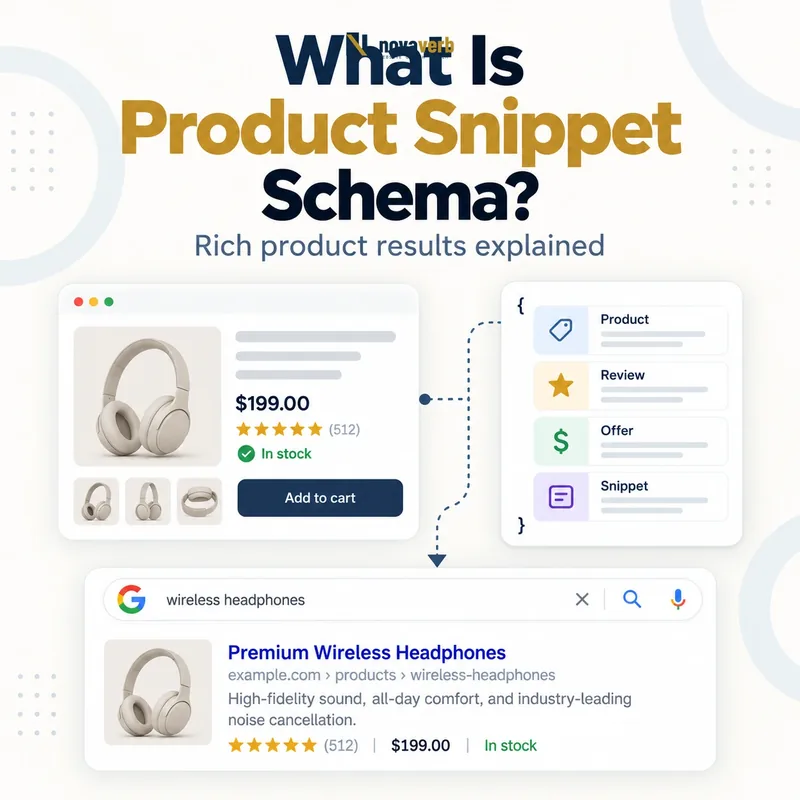
What Is Product Snippet Schema?
Product Snippet Schema is Product structured data that can add price, availability, ratings or review information to a product-focused text result.
The format describes one specific product - or variants of the same product - using Product plus at least one qualifying commercial or review path. A page may be a merchant product detail, an independent review or an aggregator that does not sell the item directly. This broader scope separates product snippets from merchant listings, though a seller page can be eligible for both. The markup must represent the page’s visible primary product and current facts; it cannot turn a category, generic buying guide or unrelated article into a product result. Valid structured data provides eligibility, not a guaranteed appearance, ranking change or CTR lift. The right objective is an accurate entity and evidence model that helps search systems interpret what the page already offers readers.
- Frame the decision raised by What Is Product Snippet Schema.
- Confirm its value type and the object it describes.
- Compare the markup with visible page information.
- Correct the source data or template without inventing values.
- Validate the rendered result and monitor future changes.
| Entity | Purpose | Example |
|---|---|---|
| Product | Identifies the item | Noise-canceling headphones |
| Offer | Describes one sale offer | $299 USD |
| AggregateOffer | Summarizes several offers | $249–$319 |
| Review | Represents a genuine review | Editorial evaluation |
| AggregateRating | Summarizes real ratings | 4.6 from 380 ratings |
| brand | Adds manufacturer identity | Example Audio |
- Focus on one product.
- Use visible current facts.
- Choose a qualifying property path.
- Measure outcomes without guarantees.
Product Snippet Schema should describe one visible product and its genuine offer or review evidence without promising a particular search presentation.
The decision for What Is Product Snippet Schema should rest on live, traceable evidence and a verified follow-up check.
Which Pages Are Eligible for Product Snippets?
Pages focused on one product or multiple variants of the same product can qualify, including seller pages, independent reviews and product aggregators.
A dedicated review of a laptop, a merchant page selling one shoe model and an aggregator summarizing current offers can all fit when the page’s main subject is clearly that product. A category such as “best laptops,” a listing of unrelated models, a search-results grid or a general brand profile does not satisfy single-product focus. Variant URLs need consistent product-group identity, and currency-specific offers should use distinct URLs so each page presents a stable currency. Pros and cons enhancements belong only to editorial product review pages, not merchant product pages or customer review submissions. Product facts referenced by markup must appear to users, and the page must be crawlable and indexable. Eligibility follows the page’s real content model rather than its template filename.
- Evidence for Which Pages Are Eligible for Product Snippets: the live structured-data entity and property relationship
- The expected value type and any nested object
- Visible page information that supports the structured value
- Related offer or catalog fields needed for interpretation
- A fresh validation result after the page changes
| Page type | Eligible? | Reason |
|---|---|---|
| Single-product review | Yes | One clear reviewed item |
| Merchant product detail | Yes | Specific purchasable item |
| Offer aggregator | Yes | One product across sellers |
| Product category | No | Many unrelated products |
| Best-of list | Usually no | Several primary products |
| Brand home page | No | No specific product |
- Identify the primary product.
- Check single-product focus.
- Confirm visible evidence.
- Exclude category templates.
Apply product snippet markup only when a reader can identify one primary product and see the evidence represented in the structured data.
The decision for Which Pages Are Eligible for Product Snippets should rest on live, traceable evidence and a verified follow-up check.
How Is Product Snippet Different From Merchant Listing?
Product snippets cover product information and reviews broadly, while merchant listings require that the publishing site directly sell the marked product.
Both rely on Product vocabulary, but the property and page requirements diverge. A product snippet may use Offer or AggregateOffer, and it can qualify through Review or AggregateRating evidence. A Merchant Listing Schema page needs a merchant-owned Offer and a direct purchase path, with richer commerce fields for shipping, returns, size and inventory. Merchant pages that satisfy the stricter requirements can also be eligible for product snippets. Independent reviewers should not pretend to be sellers, while sellers should not place editorial pros-and-cons markup on customer reviews or ordinary product descriptions. Keep separate QA reports and intent rules so a page passing one feature is not incorrectly assumed to satisfy the other.
- Frame the decision raised by How Is Product Snippet Different From Merchant Listing.
- Confirm its value type and the object it describes.
- Compare the markup with visible page information.
- Correct the source data or template without inventing values.
- Validate the rendered result and monitor future changes.
| Dimension | Product snippet | Merchant listing |
|---|---|---|
| Direct sale required | No | Yes |
| Offer type | Offer or AggregateOffer | Offer |
| Review emphasis | Strong | Optional commerce context |
| Pros and cons | Editorial reviews only | Not merchant pages |
| Shipping/returns | Limited focus | Expanded properties |
| Search Console report | Product snippets | Merchant listings |
- Classify seller versus reviewer.
- Use the matching offer type.
- Validate both reports separately.
- Keep pros and cons editorial.
Choose the schema path from who owns the transaction and what the page visibly does, not from which feature sounds more commercially attractive.
The decision for How Is Product Snippet Different From Merchant Listing should rest on live, traceable evidence and a verified follow-up check.
Which Product Properties Matter Most?
The most important Product properties establish an unambiguous item identity and connect it to a valid Offer, AggregateOffer, Review or AggregateRating path.
Use a precise name, representative crawlable image, visible description and known brand. Supply authentic identifiers such as GTIN, MPN, ISBN or SKU only when they belong to the exact product or variant. Do not fabricate identifiers or reuse a parent model code for every child. The qualifying evidence path depends on the page: a merchant or deal page can nest offers, while a review page can carry a genuine Review and supported rating information. For Product snippets, one of review, aggregateRating or offers is required under the documented model. More properties can clarify the entity, but completeness never excuses contradictions. Identity should align with title, canonical URL, visible specifications and related Product Variant Schema.
- Evidence for Which Product Properties Matter Most: the live structured-data entity and property relationship
- The expected value type and any nested object
- Visible page information that supports the structured value
- Related offer or catalog fields needed for interpretation
- A fresh validation result after the page changes
| Property | Role | Quality check |
|---|---|---|
| name | Names exact product | Matches page heading |
| image | Shows the product | Crawlable and representative |
| brand | Identifies maker | One accurate brand |
| gtin/mpn/isbn | Global identity | Exact valid identifier |
| sku | Merchant identity | Correct variant value |
| offers/review/rating | Qualifying evidence | Visible and genuine |
- Resolve the exact product.
- Match variant identifiers.
- Choose one qualifying evidence path.
- Compare with visible content.
Strong Product markup starts with exact item identity, then adds only the offer and review evidence the page can prove.
The decision for Which Product Properties Matter Most should rest on live, traceable evidence and a verified follow-up check.
How Should Offer and AggregateOffer Be Used?
Use Offer for one specific seller offer and AggregateOffer to summarize a genuine range of offers for the same product across sellers or conditions.
An Offer can specify price, priceCurrency, availability, condition, URL and seller. An AggregateOffer summarizes lowPrice, highPrice, offerCount and currency when the page genuinely presents multiple offers. Do not use AggregateOffer merely to show a product’s temporary sale range or variants with no visible offer comparison. Currency should be a three-letter ISO value such as USD and is required for merchant experiences when price is supplied; including it also removes ambiguity for snippets. Offer facts must be current and visible, including stock status and destination. If a site directly sells the item and targets merchant listings, choose Offer rather than AggregateOffer. Aggregators should verify seller URLs and prices instead of publishing stale summaries.
- Frame the decision raised by How Should Offer and AggregateOffer Be Used.
- Confirm its value type and the object it describes.
- Compare the markup with visible page information.
- Correct the source data or template without inventing values.
- Validate the rendered result and monitor future changes.
| Scenario | Use | Required truth |
|---|---|---|
| One seller price | Offer | Exact active offer |
| Several seller prices | AggregateOffer | Visible genuine range |
| Direct merchant page | Offer | Publisher is seller |
| Editorial review without price | Review path | No invented offer |
| Variant price range | Depends on page model | Visible represented offers |
| Expired deal | Remove/update | No stale price |
- Use Offer for one seller.
- Use AggregateOffer for real ranges.
- Show the same facts visibly.
- Refresh price and stock promptly.
Offer type should mirror the page’s actual seller evidence, with current currency, availability and destination facts.
The decision for How Should Offer and AggregateOffer Be Used should rest on live, traceable evidence and a verified follow-up check.
How Do Reviews and Aggregate Ratings Work?
Reviews describe genuine evaluations, while AggregateRating summarizes real ratings collected for the exact product represented on the page.
A Review needs a real author identity and review content tied to the Product. An AggregateRating needs ratingValue plus ratingCount or reviewCount, with scale bounds when they differ from the familiar default. Self-serving, fabricated or imported ratings without a defensible source undermine the markup. Every review displayed to users should be represented consistently rather than selectively marking only favorable entries. Editorial review pages may describe supported pros and cons, while merchant product pages and customer reviews are not eligible for that specific appearance. Read Review Schema, Aggregate Rating Schema and Pros and Cons Schema for their distinct property and eligibility rules.
- Evidence for How Do Reviews and Aggregate Ratings Work: the live structured-data entity and property relationship
- The expected value type and any nested object
- Visible page information that supports the structured value
- Related offer or catalog fields needed for interpretation
- A fresh validation result after the page changes
| Evidence type | What it represents | Key control |
|---|---|---|
| Review | One genuine evaluation | Real author and content |
| AggregateRating | Combined rating data | Accurate count and value |
| ratingValue | Observed score | Within stated scale |
| ratingCount | All ratings | No selective subset |
| reviewCount | Written reviews | Matches visible/source data |
| Pros/cons | Editorial assessment | Eligible review page only |
- Verify the review source.
- Match the exact product.
- Recalculate counts and values.
- Apply editorial rules correctly.
Review markup earns trust through genuine source evidence, complete counts and exact product identity - not through favorable numbers alone.
The decision for How Do Reviews and Aggregate Ratings Work should rest on live, traceable evidence and a verified follow-up check.
How Do You Write Product Snippet JSON-LD?
Write Product Snippet JSON-LD as one Product object with stable identity fields and at least one valid nested offer, review or aggregate-rating path.
Place an application/ld+json script in the rendered page and serialize it with a trusted encoder. Use canonical absolute URLs, valid schema.org types and values drawn from the same catalog or editorial records that render the page. A review article can connect its Review to the Product rather than claiming a merchant Offer it does not own. A seller page can reuse the Product and Offer model that supports merchant listings. When variants exist, connect the child Product to its ProductGroup rather than merging incompatible sizes and colors into one identity. Related JSON-LD, Breadcrumb Schema and Organization entities may coexist in a graph as long as IDs and relationships stay consistent. Test production HTML.
- Frame the decision raised by How Do You Write Product Snippet JSON-LD.
- Confirm its value type and the object it describes.
- Compare the markup with visible page information.
- Correct the source data or template without inventing values.
- Validate the rendered result and monitor future changes.
| JSON-LD field | Source | QA check |
|---|---|---|
| @type: Product | Template | Correct root entity |
| name | Catalog/editorial record | Exact item |
| image | Media record | Accessible URL |
| offers | Commerce source | Current facts |
| review | Editorial/review source | Genuine evaluation |
| aggregateRating | Ratings store | Counts reconcile |
- Use authoritative source records.
- Serialize safely.
- Keep entity IDs stable.
- Validate rendered output.
Production Product JSON-LD should serialize one authoritative product record and its real evidence, not maintain a parallel SEO-only database.
The decision for How Do You Write Product Snippet JSON-LD should rest on live, traceable evidence and a verified follow-up check.
What Product Snippet Schema Mistakes Are Common?
Common mistakes include marking category pages, combining unrelated variants, fabricating ratings, using stale offers and representing content that users cannot see.
Teams also confuse merchant and editorial eligibility, publish AggregateOffer on a direct seller page, attach pros and cons to ordinary customer reviews or copy one GTIN across different variants. PriceCurrency may be absent, availability may stay InStock after checkout fails, and image URLs may be blocked. Some templates emit two conflicting Product objects from separate plugins. A rich-result test catches syntax and missing fields but cannot verify a review author, offer freshness or product identity. Crawl the rendered page, consolidate duplicate entities and compare every value with its source system. Fix the shared template or integration rather than manually patching hundreds of JSON-LD blocks. Remove markup from ineligible pages when the content model cannot support a truthful Product object.
- Evidence for What Product Snippet Schema Mistakes Are Common: the live structured-data entity and property relationship
- The expected value type and any nested object
- Visible page information that supports the structured value
- Related offer or catalog fields needed for interpretation
- A fresh validation result after the page changes
| Mistake | Evidence | Fix |
|---|---|---|
| Category marked Product | Several primary items | Remove page-level Product |
| Duplicate Product objects | Conflicting values | Consolidate identity |
| Fake rating | No source records | Remove and investigate |
| Stale offer | Checkout differs | Sync commerce source |
| Wrong variant GTIN | Identifier collision | Map exact child |
| Hidden review | Not visible on page | Render or omit evidence |
- Find duplicate entities.
- Verify identity and evidence.
- Fix authoritative data source.
- Retest affected templates.
The highest-priority errors are false product identity, ratings and commercial facts because they mislead users even when syntax passes.
Start with a relevant free SEO check, continue the evidence workflow in Site Health, and review pricing when comparing continuous monitoring with a one-time manual review.
The decision for What Product Snippet Schema Mistakes Are Common should rest on live, traceable evidence and a verified follow-up check.