
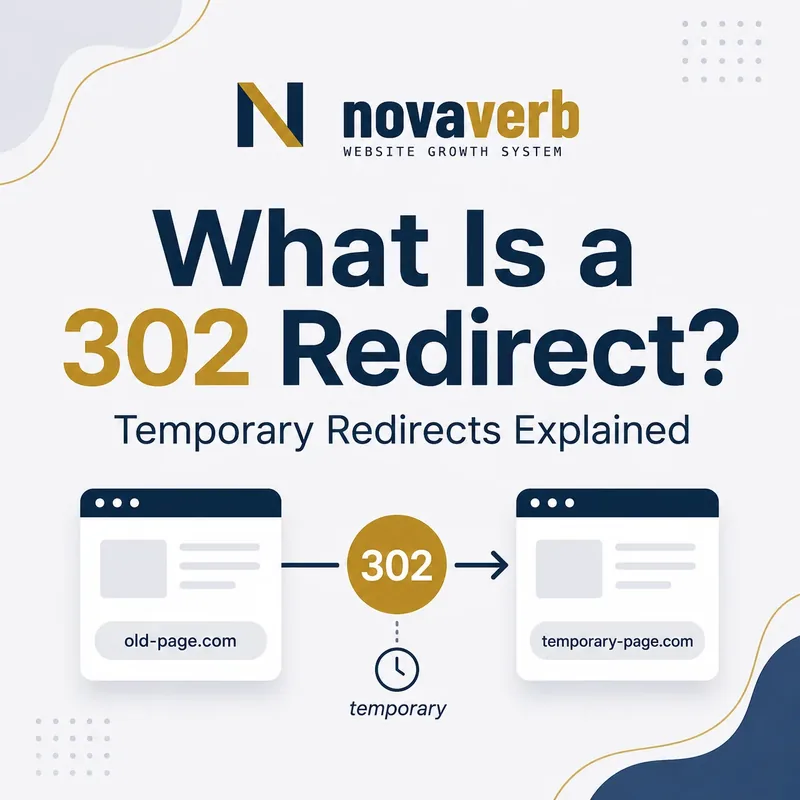
A 302 redirect is an HTTP response that temporarily sends users and crawlers from one URL to another. It indicates that the alternative destination is temporary and that the original URL is expected to remain the long-term address after the temporary condition ends.
Request:
https://example.com/original-page/

Response:
HTTP/1.1 302 Found
Location: https://example.com/temporary-page/

Temporary destination:
https://example.com/temporary-page/
A browser normally follows the Location response header and displays the temporary destination. Unlike a permanent redirect, a correctly used 302 does not communicate that the target should permanently replace the source URL.
Trace a live response with the HTTP Status & Redirect Checker. Use Crawl Explorer when you need to inspect temporary redirects, chains and final destinations across a complete website.
What Does a 302 Redirect Mean?
The HTTP status code 302 Found means that the requested resource is temporarily available at another URL identified in the Location response header. The source URL is still intended to remain the long-term address.
A complete 302 response contains several distinct parts:
- Source URL: The original address requested by the browser or crawler.
- Status code:
302, indicating a temporary redirect. - Location header: The temporary destination supplied by the server.
- Temporary destination: The page users see while the redirect remains active.
- Return condition: The event that ends the redirect and restores the original route.
The browser experience can look identical to a 301 because both responses forward the user. The distinction lies in the intended duration and which URL should remain the long-term representative.
How Does a 302 Redirect Work?
A 302 redirect returns a temporary redirect response before the source page is rendered. The browser follows the supplied destination, while the source URL remains the address expected to serve the resource in the long term.
- A user or crawler requests URL A. The request reaches the server, CDN or application responsible for that route.
- The system returns
302 Found. The response indicates that another address should be used temporarily. - The Location header supplies URL B. This is the temporary destination.
- The client requests URL B. The visitor sees the alternative content or service.
- URL A remains the long-term source. When the temporary condition ends, the redirect should be removed or changed according to the new business state.
URL A
→ 302 Found
→ Location: URL B
→ URL B
→ 200 OK

Long-term URL:
URL A
Googlebot can follow the redirect to understand the destination, but a temporary redirect does not by itself tell Google that URL B should permanently replace URL A as canonical.
When Should You Use a 302 Redirect?
Use a 302 redirect when users need to visit another destination temporarily but the original URL should remain the long-term address. The temporary purpose and the condition for restoring the original route should be documented before deployment.
Common valid uses include:
- Short maintenance periods: A service page temporarily sends users to an explanation or status page.
- A/B testing: A percentage of users temporarily visits a test variation while the original URL remains primary.
- Short promotional campaigns: A stable product URL temporarily routes visitors to a limited campaign experience.
- Temporary inventory conditions: A product expected to return sends users to a relevant availability page.
- Controlled regional routing: Users temporarily receive an appropriate regional experience while retaining a route back.
- Temporary device routing: A specific device group receives an alternative interface during testing.
- Temporary service fallback: Users are routed to a backup service while the primary system is unavailable.
- Short workflow states: An application temporarily redirects users according to login, session or transaction state.
/account/ returns a 302 to /maintenance/. After maintenance, the rule is removed and /account/ resumes serving the account experience.
When Should You Not Use a 302 Redirect?
Do not use a 302 when the destination has permanently replaced the source or when no plan exists to restore the original URL. A long-term migration should use a permanent redirect that accurately reflects the resource state.
A 302 is usually inappropriate when:
- A page has permanently changed its slug.
- HTTP URLs permanently move to HTTPS.
- A website permanently selects one hostname.
- Content moves permanently to another domain.
- Two overlapping pages are permanently consolidated.
- An old product is replaced by a permanent successor.
- A deleted URL will never return.
- The destination has become the established canonical URL.
- Internal links and sitemaps have already moved permanently to the destination.
- No owner or removal condition exists for the temporary rule.
302 Redirect vs 301 Redirect
A 302 redirect communicates a temporary alternative, while a 301 redirect communicates a permanent replacement. Both forward users, but they express different expectations about which URL should remain the long-term resource.
| Dimension | 302 redirect | 301 redirect |
|---|---|---|
| Meaning | The alternative location is temporary. | The resource has moved permanently. |
| Long-term URL | The source URL normally remains primary. | The destination is intended to replace the source. |
| User behavior | The browser opens the destination. | The browser opens the destination. |
| Typical use | Maintenance, testing or short-lived routing. | Migration, consolidation or permanent URL change. |
| Internal links | May continue using the source while the condition is genuinely temporary. | Should normally be updated to the final destination. |
| Sitemap strategy | Usually retains the long-term source URL. | Usually replaces the source with the final canonical destination. |
| Removal plan | Requires a defined condition for restoring the original route. | Often remains active while the old URL can receive meaningful requests. |
For permanent migrations, review What Is a 301 Redirect?.
302 Redirect vs 307 Redirect
Both 302 and 307 represent temporary redirects, but 307 explicitly requires the client to preserve the original HTTP method and request body. That distinction matters for forms, APIs and transactions using methods such as POST.
| Dimension | 302 Found | 307 Temporary Redirect |
|---|---|---|
| Duration | Temporary | Temporary |
| Browser navigation | Redirects the request to another URL. | Redirects the request to another URL. |
| HTTP method | Historical client behavior may convert some non-GET requests into GET. | The method must be preserved. |
| Request body | May not be preserved consistently by all historical behavior. | Must be preserved. |
| Typical use | Temporary navigation for ordinary pages. | Temporary routing where method and body preservation are required. |
302 Redirect vs 307 Redirect
Both 302 and 307 represent temporary redirects, but 307 explicitly requires the client to preserve the original HTTP method and request body. That distinction matters for forms, APIs and transactions using methods such as POST.
| Dimension | 302 Found | 307 Temporary Redirect |
|---|---|---|
| Duration | Temporary | Temporary |
| Browser navigation | Redirects the request to another URL. | Redirects the request to another URL. |
| HTTP method | Historical client behavior may convert some non-GET requests into GET. | The method must be preserved. |
| Request body | May not be preserved consistently by all historical behavior. | Must be preserved. |
| Typical use | Temporary navigation for ordinary pages. | Temporary routing where method and body preservation are required. |
302 Redirect vs Canonical Tag
A 302 temporarily forwards users to another page, while a canonical tag leaves the current page accessible and proposes a preferred representative for duplicate or substantially similar content.
| Dimension | 302 redirect | Canonical tag |
|---|---|---|
| User experience | The visitor is sent to another URL. | The current URL remains visible. |
| Primary purpose | Provide a temporary alternative route. | Select a representative among duplicate or similar URLs. |
| Source response | Returns an HTTP redirect response. | Usually returns its normal successful response. |
| Content relationship | The destination should solve the immediate temporary need. | The pages should contain duplicate or substantially similar primary content. |
| Removal condition | The redirect should end when the temporary state ends. | The relationship can remain while the duplicate URLs continue to exist. |
Review What Is a Canonical Tag? before consolidating similar URLs.
Can Google Treat a 302 as a Permanent Redirect?
Google may interpret a long-standing temporary redirect as a permanent move when the wider website consistently indicates that the destination has replaced the source. This does not make 302 the correct status for a planned permanent migration.
Signals that can contradict temporary intent include:
- The 302 remains active indefinitely.
- Every internal link points to the destination.
- The source has disappeared from the current sitemap.
- The destination is the only URL exposed in navigation.
- The source never resumes serving its own content.
- The source or related pages declare the destination canonical.
- External references increasingly use the destination.
- No operational plan exists to restore the original route.
How Long Can a 302 Redirect Stay Active?
There is no universal maximum duration for a 302 redirect, but it should remain active only while the documented temporary condition exists. Duration must be governed by the business event rather than an arbitrary SEO number.
The appropriate review schedule depends on:
- The maintenance window
- The planned A/B test duration
- The campaign start and end dates
- The expected inventory-restoration date
- The service-recovery condition
- The legal or operational approval period
- The risk of users bookmarking the temporary destination
- The effect on crawling, analytics and conversion tracking
A 302 can be technically active for a long period, but a redirect that has no realistic removal condition is no longer being managed as temporary.
Should Internal Links Point Through a 302 Redirect?
When the redirect is genuinely short-lived, internal links may continue pointing to the long-term source URL. Replacing every internal link with the temporary destination can contradict the claim that the destination is only temporary.
Use these distinctions:
- Short maintenance: Keep normal links pointing to the source and let the source temporarily redirect.
- A/B testing: Keep the original URL as the stable public reference while the testing system routes selected users.
- Temporary regional experience: Keep navigation consistent and provide users with a route to change regions.
- Permanent destination adoption: Update internal links and change to a permanent migration strategy.
- Long chains: Do not link to a URL that passes through multiple temporary or permanent hops.
If the temporary destination must be linked for a specific workflow, keep its role narrow and avoid presenting it as the universal long-term URL.
Should a 302 URL Stay in the XML Sitemap?
When the source URL remains the intended long-term canonical page, it can remain in the sitemap during a short temporary redirect. The temporary destination should not automatically replace it in the sitemap.
A coherent temporary setup usually means:
- The source remains the intended long-term URL.
- The source remains the sitemap URL when the temporary period is short and controlled.
- The destination is not added merely because it currently receives redirected traffic.
- The destination is excluded from the sitemap when it is only a temporary service or test page.
- The sitemap strategy is reviewed if the redirect continues beyond the expected period.
If the destination becomes the real long-term page, the site should update the redirect type, internal links, canonical tags and sitemap rather than maintaining a contradictory temporary configuration.
Create and validate sitemap entries with the XML Sitemap Generator & Validator.
What Is a 302 Redirect Chain?
A 302 redirect chain occurs when a temporary redirect points to another redirect before the client reaches a final page. Mixed temporary and permanent hops make it difficult to determine which URL should remain the long-term representative.
URL A
→ 302 URL B
→ 301 URL C
→ 302 URL D
→ 200 Final Page
Chains can create:
- Additional HTTP requests and slower navigation
- Conflicting permanent and temporary meaning
- Harder debugging and rollback
- Greater risk of loops or broken intermediate URLs
- Unclear canonical and sitemap decisions
- Inconsistent analytics attribution
Use the workflow in Check Redirect Chains and HTTP Status Codes in 5 Minutes.
What Is a 302 Redirect Loop?
A 302 redirect loop repeatedly sends a request between temporary destinations without reaching a final page. The browser eventually stops following the route and displays a redirect error.
URL A
→ 302 URL B
→ 302 URL A
→ 302 URL B
→ continues until the client stops
Common causes include:
- Regional routing that repeatedly changes the user’s country selection
- Device detection that alternates between mobile and desktop URLs
- Login logic that sends authenticated and unauthenticated states back to each other
- Cookie conditions that are never saved successfully
- Conflicting HTTPS rules between the CDN and application
- Competing redirect plugins or server rules
- Regular expressions that capture their own destination
How Do You Implement a 302 Redirect?
Implement a 302 at the server, CDN, application or CMS layer that controls the source URL. The rule should identify the exact temporary destination and include an operational plan for removing or changing it.
Apache
Redirect 302 /temporary-page/ https://example.com/temporary-destination/Nginx
location = /temporary-page/ {
    return 302 https://example.com/temporary-destination/;
}
PHP
<?php
header(
    'Location: https://example.com/temporary-destination/',
    true,
    302
);
exit;
?>
WordPress
A WordPress 302 can be configured through server rules, the hosting platform, application code or a redirect-management plugin. Avoid controlling the same route in several systems because overlapping rules can create chains or loops.
How Do You Check a 302 Redirect?
Check the source response, Location header, full redirect path, destination status and documented temporary purpose. Seeing another page in the browser does not prove that the source returned the intended 302 status.
- Request the exact source URL. Include the correct protocol, hostname, path and relevant parameters.
- Record the first status. Confirm that the response is
302 Found. - Inspect the Location header. Verify the intended temporary destination.
- Follow every redirect hop. Record all intermediate URLs and status codes.
- Confirm the final response. The destination should return the expected usable result.
- Validate the temporary purpose. Confirm why the original URL is expected to resume its long-term role.
- Review the destination canonical. Check for unintended canonical conflicts.
- Review indexing controls. Confirm whether the destination is intentionally indexable or noindexed.
- Review internal links and sitemap membership. They should remain consistent with the source being long-term.
- Confirm the owner and review date. The redirect requires an explicit end condition.
Run the test with the HTTP Status & Redirect Checker.
Common 302 Redirect Mistakes
The most serious 302 mistakes use temporary status for permanent migrations, leave short-lived routing active indefinitely or create inconsistent signals about the long-term URL.
| Mistake | Why it causes problems | Preferred correction |
|---|---|---|
| Using 302 for a permanent migration | The status does not describe the actual long-term move. | Use an appropriate permanent redirect. |
| No review or removal date | The temporary rule can remain active indefinitely. | Assign an owner, review date and end condition. |
| Redirecting to an unrelated page | The destination does not solve the temporary user need. | Select a relevant destination or keep the source available. |
| Creating mixed redirect chains | Temporary and permanent meanings become unclear. | Point directly to one final temporary destination. |
| Creating a redirect loop | No final content can be reached. | Remove conflicting routing conditions. |
| Destination returns an error | The temporary route fails its basic user purpose. | Restore the destination or disable the redirect. |
| Destination canonicalizes unexpectedly | The canonical relationship conflicts with the temporary journey. | Document and align canonical behavior. |
| Sitemap switches to the temporary destination | The site begins presenting the temporary page as long-term. | Keep the intended canonical source in the sitemap. |
| All internal links change to the destination | The site architecture contradicts temporary intent. | Retain the source as the stable route where appropriate. |
| POST behavior is not tested | The method or request body may not behave as expected. | Use 307 when method preservation is required. |
| Automatic geo redirect has no override | Users and crawlers can become trapped in an unsuitable region. | Provide a stable selector and accessible alternatives. |
| Cookie routing has no fallback | Blocked or failed cookies can create loops. | Define a safe default route. |
302 Redirect Checklist
A 302 redirect passes QA when the temporary purpose is documented, the source remains the intended long-term URL and every routing condition has a defined removal or rollback plan.
- The redirect purpose is genuinely temporary.
- The source remains the intended long-term URL.
- The source URL is recorded exactly.
- The destination URL is recorded exactly.
- The source returns HTTP 302.
- The Location header is correct.
- The destination solves the temporary user need.
- The destination returns a valid final response.
- No unnecessary intermediate hop exists.
- No redirect loop exists.
- HTTP method behavior has been tested.
- Request-body behavior has been tested where relevant.
- The canonical strategy is documented.
- The sitemap retains the intended canonical URL.
- Internal links remain consistent with temporary intent.
- Mobile routing has been tested.
- Desktop routing has been tested.
- Geo-routing behavior has been tested.
- Cookie and session fallbacks work.
- Crawler access has been tested.
- Analytics attribution is preserved.
- The deployment date is recorded.
- The responsible owner is recorded.
- The review date is recorded.
- The removal or rollback condition is documented.
Frequently Asked Questions About 302 Redirects
What is a 302 redirect?
Is a 302 redirect temporary?
What is the difference between 301 and 302?
Does a 302 redirect affect SEO?
Can Google treat a 302 as permanent?
How long should a 302 remain active?
Does a 302 pass SEO signals?
Should internal links point to the temporary destination?
Should a 302 source remain in the sitemap?
What is the difference between 302 and 307?
Can a 302 create a redirect loop?
How can I check a 302 redirect?
Verify Temporary Redirects Before They Become Permanent Problems
Start with the exact source URL and confirm that the first response is truly temporary. Follow every hop, inspect the destination and verify that internal links, sitemap membership and canonical signals still support the intended long-term source URL.
Use the free redirect checker for one URL. Move to Crawl Explorer when you need a complete temporary-redirect inventory, or use Site Health Audit to prioritize loops, chains and destination errors across a website.
Novaverb connects redirect status, full response paths, canonical evidence and internal links so teams can distinguish a controlled temporary route from an accidental permanent migration.
Use the Decision Ladder to decide whether a URL should return to its original state, remain temporarily redirected or move permanently to a new destination.