What Is Member Program Schema?
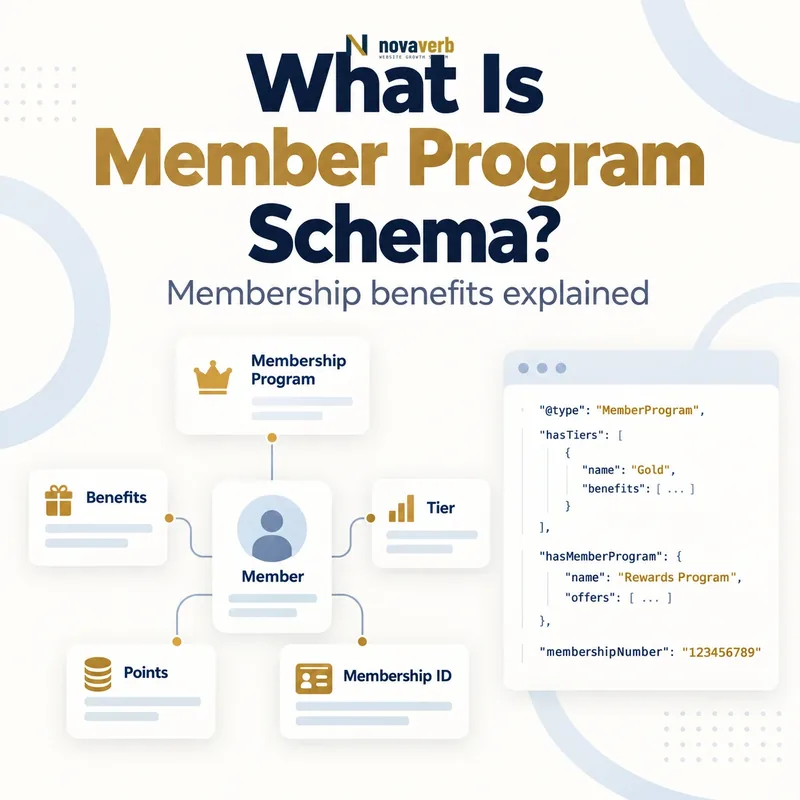
Member Program Schema is structured data that describes a merchant loyalty program, its membership tiers, entry requirements and tier-level benefits.
The core graph nests MemberProgram under an Organization or OnlineStore through hasMemberProgram. Each program contains at least one MemberProgramTier, allowing a merchant to distinguish entry-level, paid and earned-status memberships. The markup should mirror a visible loyalty page where shoppers can understand how to join, what they receive and which restrictions apply. It can support richer interpretation of loyalty benefits in eligible commerce experiences, but it is not a ranking switch and does not guarantee a special result. Build it as a durable representation of customer-facing rules, not as promotional copy hidden from buyers.
- Frame the decision raised by What Is Member Program Schema.
- Confirm its value type and the object it describes.
- Compare the markup with visible page information.
- Correct the source data or template without inventing values.
- Validate the rendered result and monitor future changes.
| Entity | Role | Example |
|---|---|---|
| Organization | Program owner | Example Store |
| MemberProgram | Named loyalty system | Rewards Plus |
| MemberProgramTier | Specific membership level | Gold |
| Offer benefit | Product-level value | Member price or points |
- Publish visible program terms.
- Define the owning organization.
- Model each genuine tier.
A strong loyalty graph begins with a real program whose public terms are complete and current.
The decision for What Is Member Program Schema should rest on live, traceable evidence and a verified follow-up check.
How Does Member Program Schema Work?
Member Program Schema works by defining the program once at organization level and referencing its tiers from qualifying product prices, points or policy benefits.
The organization record establishes program identity, while tier records describe names, benefits and qualification requirements. Product offers can then use a stable tier reference to identify a member-only price or the points earned from a purchase. This avoids restating the entire loyalty program on every product page. A machine should be able to follow the reference from an offer back to one unambiguous tier and from that tier back to the merchant’s program. Human shoppers should see the same regular price, member price, point rule and eligibility requirement. If checkout applies geography, enrollment or payment-method restrictions, the visible page must disclose them rather than allowing the graph to imply universal access.
- Evidence for How Does Member Program Schema Work: the live structured-data entity and property relationship
- The expected value type and any nested object
- Visible page information that supports the structured value
- Related offer or catalog fields needed for interpretation
- A fresh validation result after the page changes
| Layer | Question answered | Typical property |
|---|---|---|
| Program | What is the loyalty system? | hasMemberProgram |
| Tier | Who qualifies? | hasTiers |
| Benefit | What does the tier provide? | hasTierBenefit |
| Offer | Which price or points apply? | validForMemberTier |
- Define the program identity.
- Create stable tier records.
- Attach eligible offer benefits.
- Compare the graph with checkout.
The model works when every tier reference resolves to rules the shopper can verify before purchase.
The decision for How Does Member Program Schema Work should rest on live, traceable evidence and a verified follow-up check.
Which MemberProgram Properties Are Required?
A useful MemberProgram needs a truthful name, a benefit-focused description and one or more tiers, with a single relevant signup URL when available.
The program name should match branding used on the website and in enrollment flows. Its description should explain primary benefits without exaggerated savings. hasTiers contains the actual membership levels; collapsing materially different tiers into one record makes member prices and point rates hard to interpret. A url can lead to the public page where a shopper joins or reviews terms. Keep administrative details connected through Organization Schema. Do not add placeholder tiers, internal campaign codes or unpublished future benefits merely to make the object appear more complete.
- Frame the decision raised by Which MemberProgram Properties Are Required.
- Confirm its value type and the object it describes.
- Compare the markup with visible page information.
- Correct the source data or template without inventing values.
- Validate the rendered result and monitor future changes.
| Property | Purpose | Quality check |
|---|---|---|
| name | Identifies the program | Matches public branding |
| description | Summarizes primary benefits | Visible and specific |
| hasTiers | Lists membership levels | At least one real tier |
| url | Points to enrollment information | One accessible URL |
- Use customer-facing names.
- Describe concrete benefits.
- Link to accessible enrollment terms.
Complete required fields with accurate program facts before adding optional detail.
The decision for Which MemberProgram Properties Are Required should rest on live, traceable evidence and a verified follow-up check.
How Should Loyalty Tiers Be Modeled?
Model each loyalty tier as a distinct MemberProgramTier with its public name, benefits, qualification rule and stable identifier.
Tier names such as Member, Silver and Gold should match the website exactly. hasTierBenefit distinguishes loyalty points from member-only prices; a tier may support both when both are real. hasTierRequirement can express an applicable spending threshold, paid subscription, card requirement or clear text rule. A stable @id is valuable because product prices and other policy objects can reference the same tier without duplicating it. Do not merge free and paid tiers that have different terms, and do not encode invitation-only status as publicly attainable unless the visible program explains qualification.
- Evidence for How Should Loyalty Tiers Be Modeled: the live structured-data entity and property relationship
- The expected value type and any nested object
- Visible page information that supports the structured value
- Related offer or catalog fields needed for interpretation
- A fresh validation result after the page changes
| Tier element | What it communicates | Example |
|---|---|---|
| name | Public level label | Gold |
| hasTierBenefit | Benefit category | Loyalty price |
| hasTierRequirement | How a shopper qualifies | $500 annual spend |
| @id | Stable graph reference | #rewards-gold |
| url | Tier-specific details | Public terms page |
- Inventory all active tiers.
- Assign stable identifiers.
- Encode benefits and requirements.
- Test every product reference.
A tier is ready when its identity, qualification and benefit match the enrollment experience.
The decision for How Should Loyalty Tiers Be Modeled should rest on live, traceable evidence and a verified follow-up check.
How Are Member Prices Connected to Products?
Connect member prices through UnitPriceSpecification under an Offer and identify the eligible tier with validForMemberTier.
The regular price must remain present so a member price has a valid comparison point. A separate UnitPriceSpecification can state the eligible price and currency, then reference the appropriate MemberProgramTier. Multiple tiers may share a price, or separate price specifications may represent different tier prices. Do not confuse a public sale price with a loyalty price: public promotions do not require membership, while tier prices do. If a price is personalized, coupon-dependent or unavailable to every member in the referenced tier, a single fixed member-price statement may be misleading. Keep the product relationship aligned with Product Schema and the actual offer.
- Frame the decision raised by How Are Member Prices Connected to Products.
- Confirm its value type and the object it describes.
- Compare the markup with visible page information.
- Correct the source data or template without inventing values.
- Validate the rendered result and monitor future changes.
| Price type | Audience | Markup approach |
|---|---|---|
| Regular price | All eligible buyers | Offer price |
| Public sale price | All buyers during sale | Sale price specification |
| Member price | Named loyalty tier | validForMemberTier |
| Personalized price | Individual shopper | Do not publish as universal tier price |
- Retain the regular comparison price.
- Use the correct ISO currency.
- Reference one unambiguous tier.
- Confirm the checkout amount.
Publish a member price only when every shopper in the referenced tier can receive it under the visible terms.
The decision for How Are Member Prices Connected to Products should rest on live, traceable evidence and a verified follow-up check.
How Are Loyalty Points Represented?
Represent loyalty points with membershipPointsEarned and connect the value to a tier that explicitly offers loyalty-point benefits.
At program level, the points value can describe how many points are earned per unit of currency when that is the true rule. At product-offer level, points may describe the amount earned for that specific purchase. The scope must be obvious: five points per dollar is not the same as five points for an entire order. Tier multipliers, excluded categories, taxes, shipping charges and rounding can change the calculation, so structured data should not flatten a complex rule into a false universal number. If point values change frequently, derive markup from the same commerce configuration that calculates checkout rewards and monitor for stale output.
- Evidence for How Are Loyalty Points Represented: the live structured-data entity and property relationship
- The expected value type and any nested object
- Visible page information that supports the structured value
- Related offer or catalog fields needed for interpretation
- A fresh validation result after the page changes
| Points rule | Meaning | Verification |
|---|---|---|
| 5 per $1 | Program earning rate | Compare eligible spend |
| 500 per product | Item-level award | Test product offer |
| 2× event bonus | Temporary promotion | Use only while active |
| Category exclusion | No points on selected items | Do not imply universal earning |
- Identify the earning unit.
- Separate program and product scope.
- Apply tier eligibility.
- Test exclusions and rounding.
Point markup is trustworthy when its unit, scope and tier eligibility reproduce the live reward calculation.
The decision for How Are Loyalty Points Represented should rest on live, traceable evidence and a verified follow-up check.
Can Member Program Schema Apply to SaaS?
Member Program Schema can apply to SaaS only when the business runs a genuine loyalty or membership program distinct from ordinary software subscription plans.
A Basic, Pro or Enterprise software plan is usually a product package, not a loyalty tier. Calling pricing plans MemberProgramTier misrepresents the commercial model when customers are buying different software entitlements rather than earning member benefits. A SaaS company could legitimately operate a separate partner, customer-rewards or paid-membership program that grants loyalty prices or points across eligible purchases. In that case, define the program transparently and connect only relevant benefits. Describe the software itself with SoftwareApplication Schema and its prices with offers. Novaverb sells SEO software; its plan levels should not be relabeled as loyalty tiers solely to target a commerce feature.
- Frame the decision raised by Can Member Program Schema Apply to SaaS.
- Confirm its value type and the object it describes.
- Compare the markup with visible page information.
- Correct the source data or template without inventing values.
- Validate the rendered result and monitor future changes.
| Business construct | MemberProgram? | Reason |
|---|---|---|
| Monthly SaaS plan | Usually no | It is a product subscription |
| Enterprise package | No | Negotiated software entitlement |
| Customer rewards club | Potentially yes | Separate loyalty benefits |
| Partner points program | Potentially yes | Real earning and redemption rules |
- Separate subscriptions from loyalty.
- Document real earning or membership rules.
- Avoid relabeling product packages.
Use loyalty markup for loyalty relationships, not as a replacement vocabulary for SaaS pricing plans.
The decision for Can Member Program Schema Apply to SaaS should rest on live, traceable evidence and a verified follow-up check.
What Member Program Schema Mistakes Are Common?
Common mistakes include treating plans as tiers, omitting the regular price, referencing nonexistent tiers and publishing benefits that differ from checkout.
Syntax can be valid while the commercial story is wrong. A copied template may name Gold membership even though the program page calls it Premium, or a product may reference a fragment identifier that no longer exists. Teams sometimes publish member-only prices without showing the current regular price, encode temporary coupons as permanent loyalty benefits, or claim points on excluded products. Hidden terms create another problem: the markup states a benefit, but shoppers cannot verify eligibility until after login. Audit graph connections, visible terms and real transactions together rather than assuming a validator detects business contradictions.
- Evidence for What Member Program Schema Mistakes Are Common: the live structured-data entity and property relationship
- The expected value type and any nested object
- Visible page information that supports the structured value
- Related offer or catalog fields needed for interpretation
- A fresh validation result after the page changes
| Mistake | Why it matters | Correction |
|---|---|---|
| Plan labeled as tier | Wrong entity meaning | Use product offer modeling |
| Broken tier @id | Disconnected benefit | Restore stable reference |
| No regular price | Missing comparison | Publish current base price |
| Coupon as member price | Wrong eligibility | Model only true tier pricing |
| Stale points rate | False reward promise | Sync with commerce rules |
- Validate the JSON-LD graph.
- Resolve every tier identifier.
- Compare public terms.
- Test member and nonmember checkout.
The highest-priority errors are those that create a price or reward promise checkout does not honor.
Start with a relevant free SEO check, continue the evidence workflow in Site Health, and review pricing when comparing continuous monitoring with a one-time manual review.
The decision for What Member Program Schema Mistakes Are Common should rest on live, traceable evidence and a verified follow-up check.