
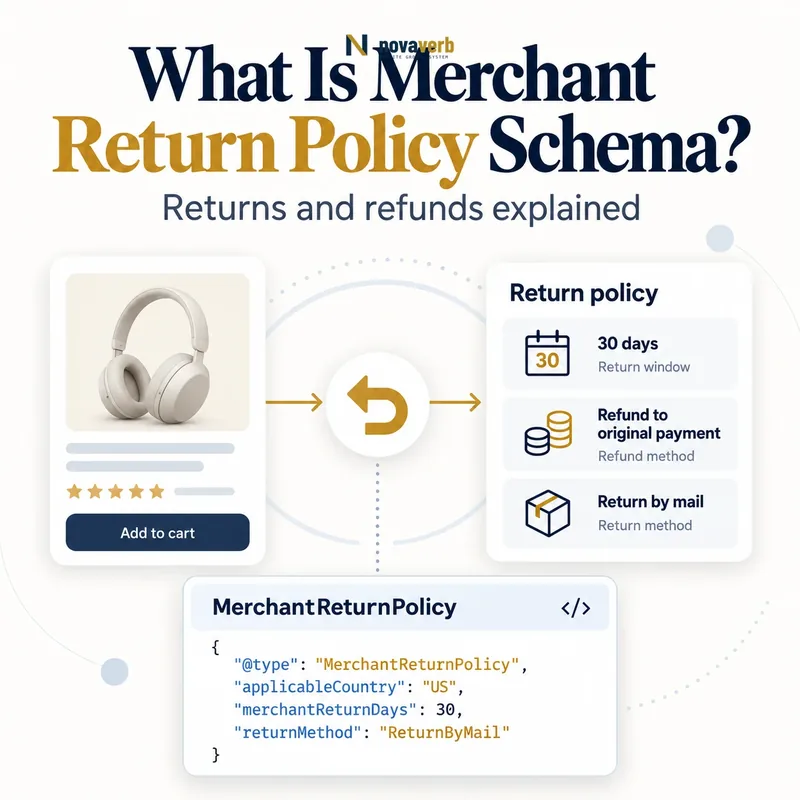
What Is Merchant Return Policy Schema?
A standard policy can be nested under an Organization or OnlineStore through hasMerchantReturnPolicy. A product-specific exception can be nested under the relevant Offer, using the supported subset of properties. The markup should mirror the policy customers can read and use.
It does not create a legal return right, override checkout terms or guarantee display beside a product. It usually describes merchant product returns, not SaaS subscription cancellation or service-refund terms. Digital products require a truthful policy and applicable vocabulary rather than being forced into a physical-return model.
- Frame the decision raised by What Is Merchant Return Policy Schema.
- Confirm its value type and the object it describes.
- Compare the markup with visible page information.
- Correct the source data or template without inventing values.
- Validate the rendered result and monitor future changes.
| Property | Represents | Evidence source |
|---|---|---|
| applicableCountry | Markets covered by policy | Sales and returns operations |
| returnPolicyCategory | Finite, unlimited or no returns | Published policy |
| merchantReturnDays | Return window from delivery | Returns system |
| returnMethod | Mail, store or kiosk route | Operational workflow |
| returnFees | Who bears return cost | Customer terms |
| refundType | Cash, original method or store credit outcome | Refund policy |
| itemCondition | Accepted product conditions | Inspection rules |
| returnLabelSource | How label is obtained | Returns portal |
| merchantReturnLink | Canonical policy or service URL | Public returns page |
- Describe the actual merchandise return process.
- Match public terms and operational systems.
- Keep service cancellation separate from product returns.
Merchant return policy schema is a machine-readable version of real product-return operations, not a substitute for customer terms or legal review.
The decision for What Is Merchant Return Policy Schema should rest on live, traceable evidence and a verified follow-up check.
How Does MerchantReturnPolicy Schema Work?
A parser reads the applicable markets and policy category, then evaluates window, method, fees, conditions and refunds. An organization-level node can cover most products. Offer-level markup should be reserved for genuine exceptions and supports a narrower property set.
Structured-data sources may compete with account or feed settings. Search consumers can apply precedence rules among APIs, merchant settings, product-level markup and organization-level markup. Therefore the site graph must agree with every higher-authority commerce source.
- Evidence for How Does MerchantReturnPolicy Schema Work: the live structured-data entity and property relationship
- The expected value type and any nested object
- Visible page information that supports the structured value
- Related offer or catalog fields needed for interpretation
- A fresh validation result after the page changes
| Layer | Policy role | Failure example |
|---|---|---|
| Organization or OnlineStore | Standard business-wide policy | Different policy copied per page |
| MerchantReturnPolicy | Operational return terms | Legal text summarized inaccurately |
| Offer override | Product-specific exception | Every product creates unnecessary override |
| Commerce feed | External return configuration | Conflicts with website markup |
| Policy page | Visible customer explanation | Markup contains hidden fee |
| Returns portal | Operational execution | Customer cannot initiate stated method |
| Seasonal override | Dated temporary window | Expired holiday rule remains active |
- Identify the standard policy source.
- Map countries and return category.
- Add methods, fees and refund terms.
- Create only necessary Offer overrides.
- Reconcile feeds and operational flows.
The graph works when one standard merchant policy establishes the baseline and only genuine product exceptions override it.
The decision for How Does MerchantReturnPolicy Schema Work should rest on live, traceable evidence and a verified follow-up check.
Organization-Level vs Product-Level Return Policies
A retailer with a 30-day standard return window should publish that once through the merchant Organization. If final-sale merchandise cannot be returned, the specific Offer can carry the supported exception. Repeating the global node on every product increases drift and duplicate output.
Product-level support is intentionally narrower, so do not assume every organization-level detail can be copied into an Offer. Connect the merchant through Organization schema and products through Product schema.
- Frame the decision raised by Organization-Level vs Product-Level Return Policies.
- Confirm its value type and the object it describes.
- Compare the markup with visible page information.
- Correct the source data or template without inventing values.
- Validate the rendered result and monitor future changes.
| Policy case | Placement | Reason |
|---|---|---|
| Standard 30-day policy | Organization hasMerchantReturnPolicy | Applies broadly |
| One final-sale item | Offer override | Product exception |
| Category-specific no-return rule | Offer or supported catalog architecture | Exception must reach affected products |
| Holiday extended window | Organization seasonal override | Dated temporary baseline change |
| Different country terms | Country-scoped policy configuration | Markets differ operationally |
| Same policy on all products | Organization only | Avoid duplication |
| Marketplace seller policy | Correct seller or offer context | Platform is not always merchant |
| SaaS cancellation terms | Subscription or service policy content | Not necessarily a merchandise return |
- Publish the standard policy once.
- Override only real exceptions.
- Keep merchant and marketplace identities distinct.
Use one organization-level baseline and sparse product-level overrides to keep policy inheritance understandable and maintainable.
The decision for Organization-Level vs Product-Level Return Policies should rest on live, traceable evidence and a verified follow-up check.
Which Return Policy Properties Matter Most?
Country values use two-letter ISO country codes. A finite return policy needs the number of days measured from delivery under current supported guidance. No-return and unlimited-window categories should not also carry a contradictory finite day count.
Use merchantReturnLink when a canonical public service or policy page is the clearest supported option. Structured details should never omit an important exception visible in the policy. Accuracy is more valuable than maximal field coverage.
- Evidence for Which Return Policy Properties Matter Most: the live structured-data entity and property relationship
- The expected value type and any nested object
- Visible page information that supports the structured value
- Related offer or catalog fields needed for interpretation
- A fresh validation result after the page changes
| Property | When used | Audit question |
|---|---|---|
| merchantReturnLink | Link-based policy option | Does it resolve to current terms? |
| applicableCountry | Structured policy option | Are all stated markets actually covered? |
| returnPolicyCategory | Structured policy option | Finite, unlimited or no returns? |
| merchantReturnDays | Finite window | Does the day count match public terms? |
| returnPolicyCountry | Return destination market | Where must the item be sent? |
| itemCondition | Accepted conditions | Are new, used or damaged items treated correctly? |
| returnMethod | Available return channels | Can customers use each method? |
| returnFees | Default cost responsibility | Who pays and under what reason? |
| refundType | Refund outcome | Cash, original method or credit? |
- Choose link or structured required fields.
- Set country scope and policy category.
- Add the finite window when applicable.
- Describe methods, costs and refunds.
- Compare every condition with visible terms.
Choose a clear required policy path, then add only the conditions customers can verify and the returns operation can honor.
The decision for Which Return Policy Properties Matter Most should rest on live, traceable evidence and a verified follow-up check.
How Should Return Windows and Seasonal Overrides Work?
Holiday policies often extend returns for purchases made during a defined period. The override needs a valid start, end and applicable window. Test the date logic across years; an end date earlier than the start date in the same year indicates a broken configuration.
Do not refresh the standard window silently after purchases. Customers need the terms that applied at the transaction. The current site markup can describe the active public policy, while order records preserve the contractual policy for each purchase.
- Frame the decision raised by How Should Return Windows and Seasonal Overrides Work.
- Confirm its value type and the object it describes.
- Compare the markup with visible page information.
- Correct the source data or template without inventing values.
- Validate the rendered result and monitor future changes.
| Window case | Markup approach | Quality check |
|---|---|---|
| Standard 30 days | Finite category plus merchantReturnDays 30 | Measured from stated delivery basis |
| No returns | MerchantReturnNotPermitted | No contradictory days |
| Unlimited returns | MerchantReturnUnlimitedWindow | Operationally true |
| Holiday extension | Seasonal override with dates | Start, end and days are coherent |
| Fixed return deadline | Supported date form where applicable | Date matches customer terms |
| Policy changed today | Update active public markup | Prior orders retain promised policy |
| Expired seasonal rule | Remove or advance deliberately | No stale holiday window |
| Country-specific window | Separate scoped policies | Each market’s terms are visible |
- Keep standard and seasonal rules separate.
- Validate date ranges across calendar years.
- Preserve purchase-time terms in commerce records.
Return-window metadata should follow active public terms while commerce records preserve the exact policy promised at purchase.
The decision for How Should Return Windows and Seasonal Overrides Work should rest on live, traceable evidence and a verified follow-up check.
How Should Return Fees, Methods and Refunds Be Marked Up?
FreeReturn means the customer is not charged for the return under the represented policy. Customer responsibility means the customer arranges or pays shipping. If the merchant charges a defined return-shipping fee, pair the correct fee enumeration with a MonetaryAmount and currency.
Customer-remorse and defective-item returns can have different fees and label sources. Restocking fees should use the correct fixed amount or percentage representation. Do not claim a full refund when only store credit is available or when original shipping is withheld without disclosure.
- Evidence for How Should Return Fees, Methods and Refunds Be Marked Up: the live structured-data entity and property relationship
- The expected value type and any nested object
- Visible page information that supports the structured value
- Related offer or catalog fields needed for interpretation
- A fresh validation result after the page changes
| Policy detail | Representation | Common conflict |
|---|---|---|
| No return shipping charge | FreeReturn | Hidden label fee |
| Customer buys postage | ReturnFeesCustomerResponsibility | Merchant portal still charges fee |
| Merchant deducts shipping fee | ReturnShippingFees plus amount | Amount or currency missing |
| Mail return | ReturnByMail | No usable mailing workflow |
| In-store return | ReturnInStore | No participating location |
| Kiosk return | ReturnAtKiosk | Kiosk unavailable in market |
| Full refund | FullRefund | Only store credit issued |
| Store credit | StoreCreditRefund | Page promises cash refund |
| Restocking percentage | Number | Fixed currency amount confused |
- Separate return reasons and channels.
- Assign who bears each cost.
- Specify fee amount and currency when needed.
- Map label source and return method.
- Verify the actual refund outcome.
Cost, method and refund metadata must describe the complete customer outcome, including reason-specific differences.
The decision for How Should Return Fees, Methods and Refunds Be Marked Up should rest on live, traceable evidence and a verified follow-up check.
Does MerchantReturnPolicy Apply to SaaS?
Software subscriptions involve access periods, renewals, cancellation timing and refund eligibility rather than shipping an item back. A downloadable software product may have a return or refund policy, but the business needs to confirm that the vocabulary accurately represents the commercial transaction.
For Novaverb and other SaaS companies, publish clear subscription, cancellation and refund terms in the appropriate legal and product surfaces. Do not claim mail returns, item conditions or shipping fees that do not exist. Software product identity can use SoftwareApplication schema.
- Frame the decision raised by Does MerchantReturnPolicy Apply to SaaS.
- Confirm its value type and the object it describes.
- Compare the markup with visible page information.
- Correct the source data or template without inventing values.
- Validate the rendered result and monitor future changes.
| Commercial model | MerchantReturnPolicy fit | Better focus |
|---|---|---|
| Physical ecommerce product | Strong fit | Return window, method and fees |
| Physical product plus subscription | Fit for physical item only | Separate subscription terms |
| SaaS monthly plan | Usually poor fit | Cancellation and refund policy |
| Annual software subscription | Usually poor fit | Renewal, cancellation and proration terms |
| Downloadable software license | Evaluate actual refund process | Digital product terms |
| SEO service contract | Not a merchandise return | Service termination and refund terms |
| Hardware with software access | Fit for hardware return | Separate software entitlement effects |
| Marketplace sale | Depends on seller and item | Identify responsible merchant |
- Model the real commercial transaction.
- Do not invent physical-return attributes for SaaS.
- Separate hardware, software and service terms.
Use MerchantReturnPolicy only when the underlying transaction truly has product-return semantics; describe SaaS terms in their actual subscription context.
The decision for Does MerchantReturnPolicy Apply to SaaS should rest on live, traceable evidence and a verified follow-up check.
What Merchant Return Policy Mistakes Are Common?
Multiple sources create additional risk. Merchant settings, feeds, product markup and organization markup may disagree, and the strongest source may override the website node. Teams often validate JSON-LD without comparing the value actually used downstream.
Operational drift is equally serious. A policy can promise in-store returns where locations no longer accept them, free labels when the portal charges, or a refund window the order system rejects. Test the customer process.
- Evidence for What Merchant Return Policy Mistakes Are Common: the live structured-data entity and property relationship
- The expected value type and any nested object
- Visible page information that supports the structured value
- Related offer or catalog fields needed for interpretation
- A fresh validation result after the page changes
| Mistake | Customer or SEO risk | Correction |
|---|---|---|
| Finite category without days | Incomplete window | Add merchantReturnDays |
| Country code or scope wrong | Policy shown in wrong market | Use correct ISO codes |
| Expired seasonal override | Stale promise | Remove or update dates |
| FreeReturn but fee charged | Commercial mismatch | Fix operation or markup |
| FullRefund but credit issued | Misleading outcome | Use truthful refundType |
| Every Offer duplicates global policy | Maintenance drift | Keep organization baseline |
| Feed conflicts with page markup | Wrong effective source | Reconcile precedence |
| SaaS terms forced into returns | Incorrect model | Use subscription policy content |
- Inventory every policy source.
- Compare effective country and window rules.
- Test methods, labels and fees.
- Resolve global and product overrides.
- Remove product-return markup from unsuitable services.
Return-policy quality depends on cross-source consistency and real returns operations, not schema validation alone.
Start with a relevant free SEO check, continue the evidence workflow in Site Health, and review pricing when comparing continuous monitoring with a one-time manual review.
The decision for What Merchant Return Policy Mistakes Are Common should rest on live, traceable evidence and a verified follow-up check.