
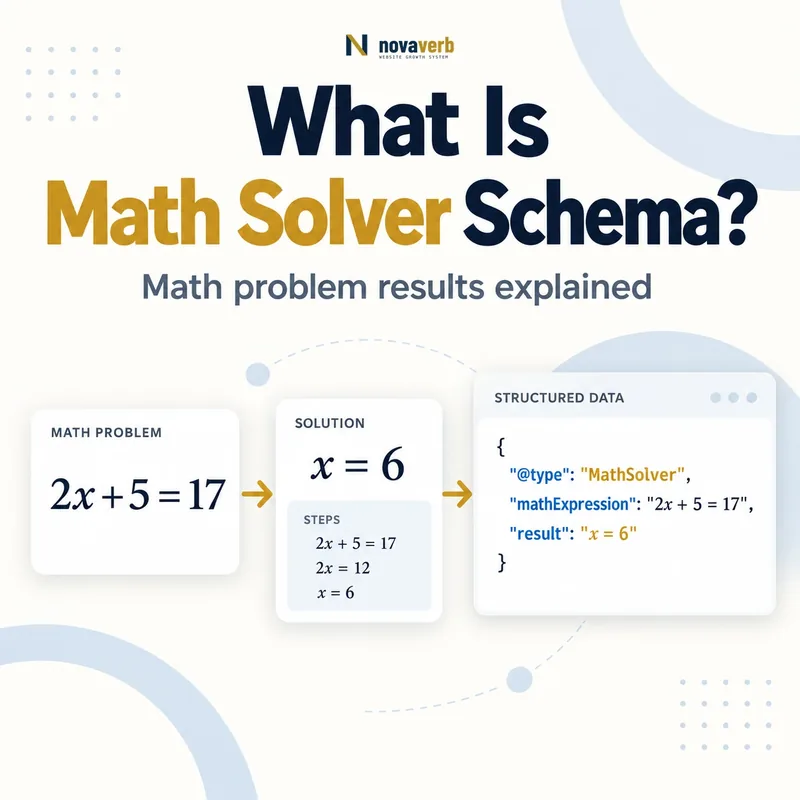
What Is Math Solver Schema?
Math Solver Schema is structured data that identifies an online math-solving tool, the problem types it handles and the URL actions that return step-by-step solutions.
The model combines MathSolver with LearningResource and one or more SolveMathAction objects. Each action declares an endpoint that accepts a mathematical expression, while its problem-type labels describe the equations or operations the endpoint can solve. This is not markup for an ordinary lesson, calculator landing page or collection of static practice questions. The tool must actually accept relevant expressions and make an accurate solution plus a walkthrough available for the initial problem. Structured data establishes eligibility for a specialized search experience; it does not guarantee inclusion, ranking improvement or higher CTR. A trustworthy implementation begins with a capable solver and treats the schema as a precise public contract for its supported inputs.
- Identify the exact page, asset, entity or relationship described in this section.
- Inspect the live implementation and retain the observed evidence.
- Compare the observation with the intended meaning and its primary specification.
- Correct any mismatch, then retest the live result.
- Record the accountable owner and review date.
| Entity | Role | Example |
|---|---|---|
| MathSolver | Identifies the tool | Algebra solver |
| LearningResource | Adds learning context | Educational utility |
| SolveMathAction | Defines an action endpoint | Solve polynomial |
| target | Accepts expression input | /solve?q={...} |
| eduQuestionType | States problem coverage | Derivative |
| usageInfo | Links privacy information | /privacy |
- Describe a real solver.
- Declare only tested problem types.
- Provide step-by-step output.
- Avoid promises about search appearance.
Primary specification: Schema.org definition for MathSolver.
Math Solver Schema is valuable only when each declared action leads to an accurate, accessible walkthrough for the problem types it claims to solve.
Who Should Use Math Solver Structured Data?
Math Solver structured data is for websites whose primary tool accepts mathematical expressions and returns accurate step-by-step solutions without hiding the initial result behind access controls.
The markup belongs on the solver site’s home page under the current technical requirements. It suits algebra, calculus, geometry, statistics or multi-domain tools when their declared endpoints genuinely process those inputs. A static blog that explains ten equations, a tutoring marketplace, a worksheet archive and a promotional affiliate page do not become solvers by linking to external calculators. The home page and action URLs must be crawlable, canonical copies should consolidate duplicates, and users arriving through the experience need access to the initial answer and walkthrough. Additional features can require an account or payment, but the promised first solution cannot be entirely blocked. Accuracy applies both to the output and to the published list of supported problem types.
- The exact page, asset, entity or relationship covered by this section
- The live implementation rather than an editor-only preview
- The primary specification or first-party record defining the expected behavior
- The validation result, accountable owner and review date
| Site pattern | Fit? | Reason |
|---|---|---|
| Interactive equation solver | Yes | Accepts expressions |
| Step-by-step calculator | Yes | Shows method and result |
| Static math article | No | No solver action |
| Worksheet library | No | Different content model |
| Affiliate directory | No | Promotional intermediary |
| Login-only solver | No | Initial walkthrough inaccessible |
- Test the live solver.
- Confirm home-page placement.
- Verify public first results.
- Exclude non-solver templates.
Use MathSolver only when the site itself delivers the declared solving action and an accessible, accurate first walkthrough.
Which MathSolver Properties Are Required?
MathSolver requires potentialAction with a SolveMathAction, mathExpression-input, target, url and usageInfo; LearningResource adds the fixed Math Solver learningResourceType.
The root may use both MathSolver and LearningResource types. potentialAction connects the entity to at least one action. The action’s target contains the endpoint template and a {math_expression_string} placeholder, while mathExpression-input declares the required input name. The root url identifies the solver and usageInfo identifies its privacy policy. When LearningResource is present, learningResourceType uses the fixed value Math Solver. Recommended language and problem-type properties improve specificity, but no optional field compensates for an action URL that fails or a solver that cannot produce the promised walkthrough.
- Identify the exact page, asset, entity or relationship described in this section.
- Inspect the live implementation and retain the observed evidence.
- Compare the observation with the intended meaning and its primary specification.
- Correct any mismatch, then retest the live result.
- Record the accountable owner and review date.
| Property | Object | Purpose |
|---|---|---|
| potentialAction | MathSolver | Nests solving actions |
| target | SolveMathAction | Action URL template |
| mathExpression-input | SolveMathAction | Declares expression variable |
| url | MathSolver | Identifies solver URL |
| usageInfo | MathSolver | Privacy policy URL |
| learningResourceType | LearningResource | Fixed Math Solver value |
- Include every required property.
- Use the exact input placeholder.
- Publish a valid privacy URL.
- Keep the endpoint operational.
A complete MathSolver object connects one truthful solver identity to a working input contract, privacy information and at least one supported action.
How Does SolveMathAction Work?
SolveMathAction maps a mathematical expression supplied through math_expression_string to a target URL that returns its solution and explanatory steps.
The target is an entry-point template such as https://example.com/solve?q={math_expression_string}. The paired annotated property uses required name=math_expression_string, allowing the incoming expression to populate the endpoint. The service must parse the expression formats expected for its declared domains, including keyboard notation or specialized forms for derivatives, integrals and limits. Encoding is critical: plus signs, braces, backslashes and Unicode symbols can change meaning when inserted into a query string. Test both simple and adversarial expressions, invalid input, long expressions and locale differences. The endpoint should preserve the submitted problem, identify assumptions, show a correct result and provide a readable derivation rather than redirecting to a generic home page.
- The exact page, asset, entity or relationship covered by this section
- The live implementation rather than an editor-only preview
- The primary specification or first-party record defining the expected behavior
- The validation result, accountable owner and review date
| Action part | Example | QA focus |
|---|---|---|
| @type | SolveMathAction | Correct action type |
| target | /solve?q={math_expression_string} | Placeholder retained |
| mathExpression-input | required name=math_expression_string | Exact variable name |
| expression | x^2-3x=0 | Correct encoding |
| response | Solution plus steps | No generic redirect |
| invalid input | Helpful error | No fabricated answer |
- Build the target template.
- Encode test expressions.
- Verify parsed meaning.
- Inspect answers and steps.
A SolveMathAction succeeds operationally only when every supported input reaches the intended solver and returns an intelligible derivation.
Which Math Problem Types Can You Declare?
Declare only documented or accurately mapped problem types that the specific action endpoint can solve reliably, using eduQuestionType on each SolveMathAction.
Problem labels include broad domains such as Algebra, Calculus, Geometry and Statistics plus specific types such as Linear Equation, Quadratic Equation, Derivative, Integral, Limit, Matrix and System of Equations. A broad label should not imply universal coverage when the solver handles only a narrow subset. If one endpoint solves polynomial equations and another solves trigonometric equations, use separate actions with matching labels. One action can declare several types when the same endpoint processes them correctly. Maintain a tested capability matrix that connects every label to representative valid, boundary and unsupported inputs. When solver behavior changes, update the structured data in the same release so the public contract never overstates coverage.
- Identify the exact page, asset, entity or relationship described in this section.
- Inspect the live implementation and retain the observed evidence.
- Compare the observation with the intended meaning and its primary specification.
- Correct any mismatch, then retest the live result.
- Record the accountable owner and review date.
| Problem label | Representative input | Coverage test |
|---|---|---|
| Linear Equation | 4x-3=2x+9 | Solve variable |
| Quadratic Equation | x^2-3x-4=0 | Return both roots |
| Derivative | d/dx (x^2+x) | Show differentiation |
| Integral | integral of x^2 | State constant |
| Matrix | Row reduce a matrix | Preserve dimensions |
| Statistics | Mean of a number set | Handle list input |
- Map labels to real capabilities.
- Test representative expressions.
- Separate endpoints when needed.
- Remove unsupported claims promptly.
Problem-type markup should be generated from a verified capability matrix, not a keyword inventory assembled for broader search exposure.
How Is Math Solver Different From Education Q&A?
Math Solver Schema describes an interactive expression-solving service, while Education Q&A Schema describes visible authored flashcards grouped as a Quiz.
A MathSolver accepts variable user input and routes it through SolveMathAction to a generated walkthrough. Education Q&A Schema represents fixed Question and Answer pairs with eduQuestionType: Flashcard. A page may teach mathematics without being a solver, and a solver may offer example questions without turning its home-page schema into a flashcard Quiz. The old Practice Problem search feature was removed in January 2026, so it should not be presented as a current rich-result opportunity. This distinction matters for content planning: use stable educational pages to teach concepts, flashcards for recall, and MathSolver only for genuine interactive computation. Avoid stacking types simply because every page mentions math.
- The exact page, asset, entity or relationship covered by this section
- The live implementation rather than an editor-only preview
- The primary specification or first-party record defining the expected behavior
- The validation result, accountable owner and review date
| Dimension | Math Solver | Education Q&A |
|---|---|---|
| Interaction | Variable expression input | Fixed flashcards |
| Root entity | MathSolver | Quiz |
| Action | SolveMathAction | No solver endpoint |
| Question type | Problem capability labels | Fixed Flashcard |
| Output | Generated steps | Authored answer |
| Placement | Solver home page | Detailed flashcard page |
- Identify page interaction.
- Separate tools from content.
- Choose one honest primary model.
- Remove retired-feature claims.
Choose the schema that matches the page’s actual learning interaction, and do not revive retired search features through misleading markup.
How Do You Write MathSolver JSON-LD?
Write MathSolver JSON-LD with MathSolver and LearningResource types, solver identity fields and a potentialAction array containing each supported SolveMathAction endpoint.
Place the object in an application/ld+json script on the home page and serialize it with a trusted encoder. Use canonical absolute URLs for url, usageInfo and every target. Add inLanguage for genuinely supported interfaces, not merely pages translated through browser controls. Each action can contain one or several eduQuestionType values tied to its tested capability. When a site offers separate localized solvers, each language page can carry its corresponding object and canonical/hreflang signals. Related JSON-LD, WebSite Schema and Breadcrumb Schema can coexist in a coherent graph without changing action requirements. Validate the production-rendered object and exercise every target.
- Identify the exact page, asset, entity or relationship described in this section.
- Inspect the live implementation and retain the observed evidence.
- Compare the observation with the intended meaning and its primary specification.
- Correct any mismatch, then retest the live result.
- Record the accountable owner and review date.
| JSON-LD field | Value pattern | Validation |
|---|---|---|
| @type | MathSolver + LearningResource | Both valid types |
| name | Public tool name | Matches page |
| url | Canonical home URL | Returns 200 |
| usageInfo | Privacy URL | Public and relevant |
| inLanguage | Supported language code | Interface truly supported |
| potentialAction | Action array | Every target tested |
- Use canonical URLs.
- Serialize safely.
- Align languages with interfaces.
- Test every action target.
Production JSON-LD should be a safe serialization of the live solver capability registry, not a static example copied outside the release process.
What Math Solver Schema Mistakes Are Common?
Common mistakes include placing markup on the wrong page, advertising unsupported problem types, breaking the expression placeholder and blocking the first solution behind login or payment.
A generic calculator often claims Calculus or Linear Algebra without producing a derivation. Other sites send every action to the home page, drop special characters from the expression, publish a stale privacy URL or use a target that returns an error for crawler traffic. Copying examples can leave fictional domains and mismatched input names in production. A validator can confirm JSON shape while missing inaccurate answers, incomplete steps or a solver that silently changes the submitted problem. Test the entire contract from structured-data extraction through URL construction, parsing, solution logic and rendered output. Remove markup from promotional or affiliate pages rather than disguising them as first-party solvers.
- The exact page, asset, entity or relationship covered by this section
- The live implementation rather than an editor-only preview
- The primary specification or first-party record defining the expected behavior
- The validation result, accountable owner and review date
| Mistake | Impact | Fix |
|---|---|---|
| Wrong placement | Feature mismatch | Use solver home page |
| Unsupported label | Misleading coverage | Correct capability registry |
| Broken placeholder | Action cannot pass input | Use exact variable |
| Generic redirect | No requested solution | Deep-link to solver result |
| Paywalled first answer | Access violation | Expose initial walkthrough |
| Incorrect math | Quality failure | Repair engine and review |
- Test declared capabilities.
- Trace target construction.
- Verify public access.
- Review mathematical output.
The highest-priority failures are inaccurate mathematics and broken user journeys, even when the markup itself passes syntax validation.