What Is a High-Quality Backlink?
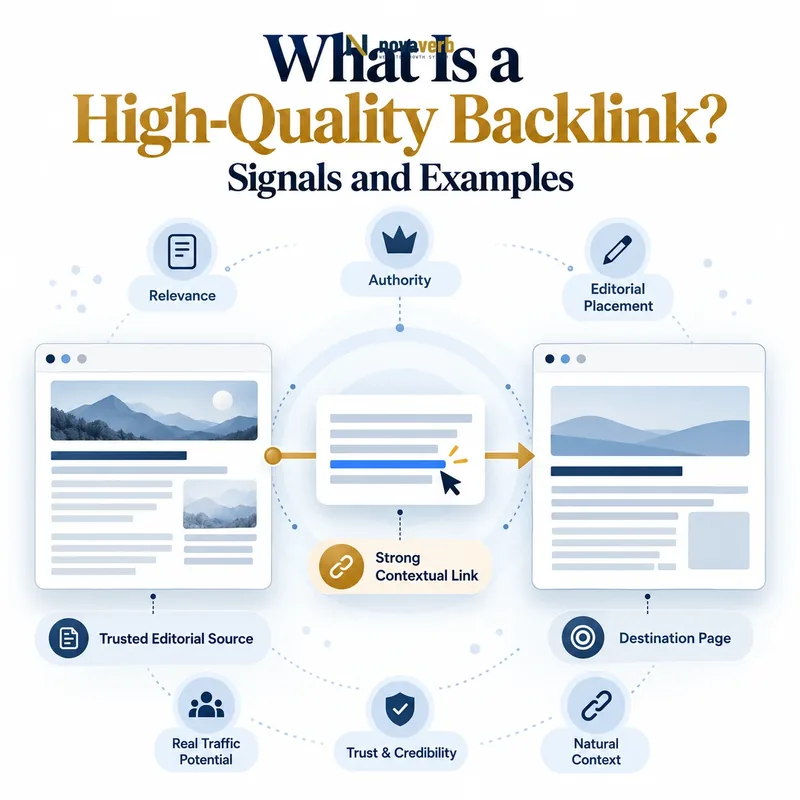
The source should be a real, accessible page with a credible purpose. The link should appear for a clear reason, describe or support its destination and lead directly to content that fulfills the expectation created before the click.
Provider metrics can help prioritize a large dataset, but they remain estimates tied to one index and model. The live referring page and destination provide the evidence for the quality review.
- Legitimate accessible source
- Topical and audience relevance
- Clear editorial or functional purpose
- Descriptive anchor and surrounding context
- Appropriate relationship attributes
- Healthy matching destination
| Quality layer | Question | Evidence |
|---|---|---|
| Source | Is the page legitimate and available? | Live referring page |
| Context | Why does the link appear? | Surrounding section |
| Anchor | What does the reader expect? | Rendered link label |
| Relationship | How is the link classified? | rel attributes and history |
| Destination | Does the final page deliver? | Status, canonical and content |
A backlink is high quality when every part of the live source-to-destination relationship supports the same reader need.
Which Signals Define Backlink Quality?
A link on a well-known domain can still be irrelevant, hidden in boilerplate or pointed at the wrong page. A link from a smaller specialist publication can be highly useful when it appears inside a trusted explanation for the exact audience your resource serves.
Review signals in groups and keep facts separate from estimates. Source response, anchor, rel attributes and destination are observable; authority and toxicity metrics are provider interpretations.
- Source legitimacy
- Page and passage relevance
- Editorial context
- Visible placement
- Anchor-to-destination alignment
- Disclosure and rel attributes
- Destination status and canonical
- Referral value when measured
| Signal | Observable fact | Interpretation |
|---|---|---|
| Source access | Page returns usable content | Relationship can be verified |
| Topic match | Passage and target discuss same need | Relevance is strong |
| Placement | Link appears in editorial content | Context is visible |
| Anchor | Label describes final page | Expectation is aligned |
| Referral visits | Analytics records sessions | Users actively follow the path |
Quality is strongest when multiple observable signals agree rather than when one provider metric looks favorable.
Why Is Relevance Important for Backlink Quality?
A general business publication can contain a deeply relevant SEO article, while an SEO website can publish an unrelated corporate announcement. Open the exact referring page and inspect the local heading and sentence.
Destination format should also fit. A passage requesting evidence should link to research, while a task-oriented recommendation may link to a working tool. Topic similarity without task alignment can still produce a weak experience.
- Audience overlap
- Source-page topic
- Local heading and paragraph
- Anchor intent
- Destination topic and format
- Final URL after redirects
| Relevance level | Strong match | Weak match |
|---|---|---|
| Audience | Readers need the destination | No likely reader need |
| Page | Same subject area | Unrelated content |
| Passage | Link supports the exact point | Link inserted without explanation |
| Anchor | Labels the next step | Misleading wording |
| Destination | Completes the task | Changes topic or intent |
Relevance becomes defensible when the source passage and final page solve adjacent parts of the same reader task.
How Do Context and Placement Affect Quality?
A resource-list link can also be useful when the section explains why each destination matters. Author-bio, partner and directory links serve legitimate roles but should be classified according to those roles rather than called contextual citations automatically.
Read What Is a Contextual Backlink? for detailed placement examples and evaluation steps.
- Editorial body citation
- Explained resource-list link
- Author or attribution link
- Partner relationship link
- Navigation and footer link
- Widget or embedded placement
| Placement | Quality question | Common interpretation |
|---|---|---|
| Editorial paragraph | Does it support the passage? | Strong contextual evidence |
| Curated resource list | Is each destination explained? | Useful when selective |
| Author bio | Does it identify the contributor? | Legitimate attribution role |
| Footer | Why is it repeated sitewide? | Structural pattern |
| Widget | Who controls the embed? | Requires relationship review |
Placement quality depends on whether the link performs a clear, legitimate role on the source page.
How Does Anchor Text Affect Backlink Quality?
Branded, exact-match, partial-match, URL and generic anchors can all be appropriate. Exact-match wording is not automatically manipulative when it is the clearest name for a tool or topic, and branded wording is not automatically strong when the destination is unrelated.
Use What Is Anchor Text? to classify anchors, then keep each example connected to its source context and destination.
- Read the full source sentence
- Check whether wording is publisher-friendly
- Resolve the final destination
- Group repeated template anchors
- Review systematic controlled patterns
- Avoid universal anchor percentages
| Anchor pattern | Potentially strong when | Needs review when |
|---|---|---|
| Branded | Destination represents the brand | Link leads elsewhere |
| Exact match | Phrase naturally labels the resource | Repeated through controlled placements |
| Partial match | Wording fits the sentence | Commercial phrase is forced |
| URL | Canonical URL is readable | URL is outdated or redirected |
| Generic | Surrounding copy supplies context | Reader cannot predict the target |
A quality anchor is the clearest honest label in its sentence, not the anchor type that matches a predetermined formula.
Do Dofollow Links Mean Higher Quality?
A nofollow citation from a relevant publication can send qualified visitors and provide attribution. A follow link in an irrelevant deceptive network can be a poor relationship. Sponsored and UGC attributes add important disclosure context rather than serving as simple quality grades.
Read Dofollow vs Nofollow Backlinks for the attribute-level distinction.
- Record the exact rel value
- Keep disclosure context
- Measure referral value separately
- Review source and placement
- Avoid equating follow with endorsement quality
- Avoid discarding nofollow links automatically
| Attribute | What it communicates | Quality conclusion |
|---|---|---|
| No rel value | Ordinary link relationship | Still requires full review |
| nofollow | Do not rely on ordinary endorsement treatment | Can remain useful |
| sponsored | Commercial relationship disclosed | Evaluate transparency and fit |
| UGC | User-generated origin disclosed | Evaluate platform and context |
Attributes are one evidence field in a backlink relationship, not a complete quality score.
Do Authority Scores Measure Backlink Quality?
Different providers crawl different pages and calculate different scores. A high score cannot prove relevance, placement or destination fit, while a low score can reflect a new or niche legitimate source.
The backlink profile guide explains how provider totals, anchors, domains and destinations fit together. Keep authority metrics labeled as comparative estimates.
- Use one provider consistently
- Record the metric name and refresh time
- Do not combine unlike scores
- Open important source pages
- Check page-level context
- Keep score separate from direct evidence
| Metric use | Appropriate | Inappropriate |
|---|---|---|
| Queue sorting | Prioritize records for review | Declare quality automatically |
| Competitor comparison | Compare within one provider and scope | Merge different provider values |
| Trend monitoring | Track the same metric over time | Treat movement as a search-engine verdict |
| Source review | Add context to live evidence | Replace source-page inspection |
Authority metrics are prioritization aids, while backlink quality is established through the live relationship.
How Do You Find and Evaluate Quality Backlinks?
Start with the free backlink checker to identify sources and linked pages. Then use the backlink audit workflow to apply consistent evidence standards and priorities.
Protect valuable live citations, repair broken destination paths, reclaim important lost relationships and expand resource formats that repeatedly earn legitimate links.
- Define target and provider
- Collect backlinks and referring domains
- Group sitewide and duplicate patterns
- Open priority referring pages
- Review context, anchor and attributes
- Resolve the final destination
- Assign an action and owner
- Retest completed work
| Finding | Quality state | Action |
|---|---|---|
| Relevant live citation | Strong relationship | Protect |
| Strong source to broken target | Quality source, failed route | Repair |
| Important link removed | Lost relationship | Reclaim when appropriate |
| Uncertain placement | Incomplete evidence | Investigate |
| Repeatable earned pattern | Validated opportunity | Expand |
Quality analysis becomes useful when verified relationships lead to clear actions rather than another unowned spreadsheet.
Frequently Asked Questions About High-Quality Backlinks
- Inspect the live source
- Verify the final destination
- Keep metrics labeled as estimates
Are high-authority backlinks always high quality?
Are nofollow backlinks low quality?
Is exact-match anchor text low quality?
Are directory backlinks high quality?
How many quality backlinks do I need?
Can a small website provide a quality backlink?
Do quality backlinks guarantee rankings?
How can I check backlink quality?
A quality-backlink conclusion is credible when another analyst can reproduce every part of the relationship.
Judge the Relationship, Not Just the Score
Use Backlink Checker for the first review, manage recurring evidence in Backlinks Explorer and connect decisions through the complete SEO tools system.
- Discover the source
- Inspect the live placement
- Read anchor and context
- Verify the destination
- Protect or improve the relationship
The best backlink is a legitimate, relevant and useful path that remains verifiable over time.