What Is Link Relevance in SEO?
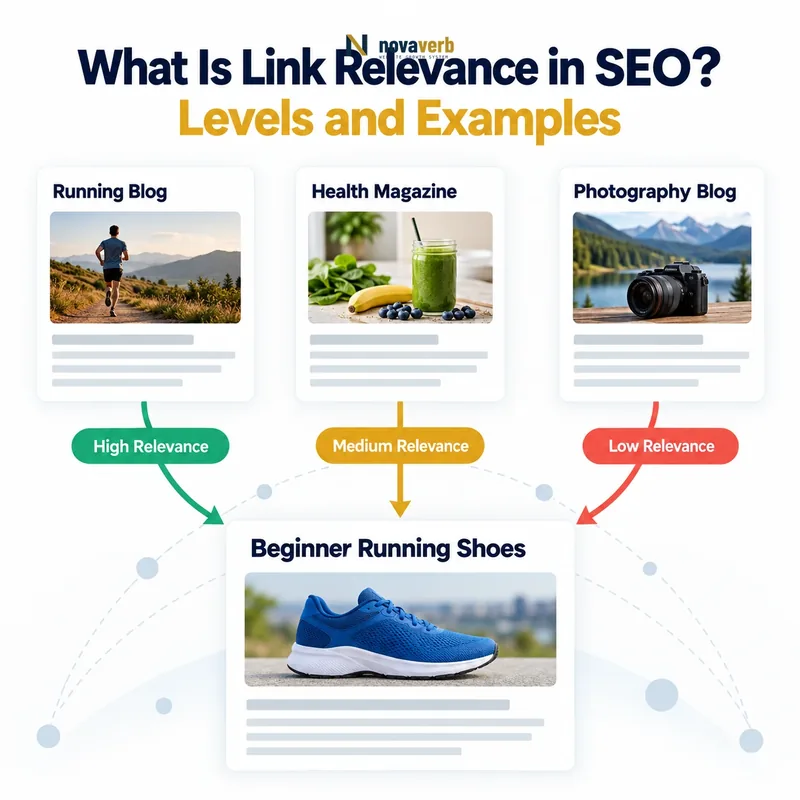
Relevance is not a binary domain label. A broad publication can contain a highly relevant specialist article, while a niche website can publish an unrelated page. The strongest evidence appears in the local source passage and the destination it recommends.
Link relevance applies to internal and external links. Internal relevance helps users move between related site pages, while backlink relevance connects an external source to your content.
- Domain and audience relationship
- Source-page topic
- Local heading and passage
- Anchor meaning
- Destination topic and format
- Reader task before and after the click
| Layer | Question | Evidence |
|---|---|---|
| Domain | Do the audiences overlap? | Site purpose and sections |
| Page | Does the source page cover a related topic? | Title and main content |
| Passage | Why does the link appear here? | Heading and surrounding sentences |
| Anchor | What does the reader expect? | Rendered link label |
| Destination | Does the final page satisfy the expectation? | Final content and status |
Link relevance is strongest when every layer leads the reader toward the same clear next step.
Why Does Link Relevance Matter?
A relevant citation helps a reader verify a claim, learn a definition or complete a task. A link inserted into unrelated copy provides no clear reason to visit the destination, even if the source domain has favorable provider metrics.
Relevance also improves analysis. It lets teams distinguish legitimate editorial relationships from sitewide repetition, broad directory listings and links that require further investigation.
- Sets an accurate click expectation
- Connects related information
- Supports attribution and evidence
- Improves referral quality
- Clarifies editorial purpose
- Helps prioritize backlink review
| Link outcome | Relevant relationship | Irrelevant relationship |
|---|---|---|
| Expectation | Destination is predictable | Click is surprising |
| Navigation | Advances the current task | Changes topic |
| Referral | Audience likely needs the page | Audience mismatch |
| Analysis | Purpose is explainable | Placement requires investigation |
Relevance matters because it gives the link a defensible purpose for the current reader, independent of ranking claims.
What Is Domain-Level Link Relevance?
A marketing publication may cover analytics, content, advertising and SEO. Its SEO section can be highly relevant to a backlink tool even though the whole domain is broad. A dedicated SEO domain may still contain a careers page with little relevance to that tool.
Use domain categories to prioritize records, then open the exact referring page. Never approve or reject a backlink solely from the homepage topic.
- Overall audience
- Primary subject areas
- Relevant site sections
- Source legitimacy
- Geographic or industry fit
- Domain ownership and purpose
| Domain pattern | Relevance interpretation | Next check |
|---|---|---|
| Specialist industry site | Likely audience overlap | Open exact page |
| Broad business publication | Section may be relevant | Inspect page topic |
| Local organization | Can be relevant to local destination | Check location and purpose |
| Unrelated automated network | Low apparent fit | Investigate ownership and placement |
Domain relevance narrows the queue, while the exact source page determines whether the individual link belongs.
What Is Page-Level Link Relevance?
Compare the source title, primary heading, section structure and audience question with the destination. A tutorial about backlink audits has clear page-level relevance to a backlink checker, audit guide or link-analysis platform.
Avoid keyword matching alone. Two pages can share words but serve different tasks, such as a definition and a commercial login page. Intent and format must align as well as topic.
- Source title and H1
- Primary search or reader intent
- Page type and format
- Audience knowledge level
- Destination role
- Topic overlap beyond shared keywords
| Source page | Destination | Page relevance |
|---|---|---|
| Backlink audit tutorial | Backlink checker | Strong task fit |
| SEO glossary | Anchor text definition | Strong explanation fit |
| General marketing news | Technical crawl endpoint | Depends on passage |
| Unrelated hiring page | SEO product page | Weak |
| Tool comparison | Matching product capability | Potentially strong with disclosure |
Page relevance requires aligned topic, intent and format rather than a few matching keywords.
What Is Passage-Level Link Relevance?
A broad page can contain a narrow section where a specialized citation is useful. Conversely, a relevant page can include one unrelated promotional link that does not support its passage.
This is why contextual backlink analysis begins with the exact location rather than the domain summary. Read enough surrounding copy to understand the link’s job.
- Local H2 or H3 topic
- Sentence containing the anchor
- Previous and next sentences
- Claim, definition or task being supported
- Placement inside editorial copy
- Relationship disclosure near the link
| Passage need | Relevant link job | Weak placement |
|---|---|---|
| Statistic needs support | Cite original research | Link generic homepage |
| Term needs definition | Link focused definition | Link unrelated service |
| Task needs execution | Link working tool | Link sales form |
| Example needs detail | Link complete case | Insert unexplained commercial anchor |
Passage relevance is strong when the reader can explain exactly what the destination contributes to the current sentence.
How Do Anchor Text and Destination Affect Relevance?
Branded, exact-match, partial-match, URL and generic anchors can all be relevant in the right sentence. Anchor category alone does not prove quality or manipulation.
Use What Is Anchor Text? to classify labels, then resolve the final URL. A relevant anchor pointing through a chain to an unrelated page creates a destination mismatch.
- Read the anchor in its full sentence
- Check wording against the final page
- Follow redirects
- Confirm final status and canonical
- Review repeated controlled patterns
- Keep anchor type separate from relevance
| Anchor | Destination | Relevance |
|---|---|---|
| backlink checker | Working backlink checker | Strong |
| Novaverb research | Named research page | Strong |
| learn more | Focused resource explained by context | Can be relevant |
| SEO guide | Generic homepage | Weak destination fit |
| free tool | Paid-only unrelated product | Misleading |
Anchor relevance is complete only when the final destination fulfills the expectation created in the source sentence.
How Do You Evaluate Backlink Relevance?
Start with the free backlink checker to discover referring pages. Then apply the backlink audit workflow so evidence, confidence and next actions remain consistent.
Use a simple conclusion such as strong, partial, weak or uncertain relevance, accompanied by the facts supporting it. Avoid converting relevance into a fabricated universal score.
- Define the target and provider
- Open the exact referring page
- Identify domain and page audience
- Read the local passage
- Record anchor, attributes and placement
- Resolve the final destination
- Assign relevance with evidence
- Choose protect, investigate or ignore
| Rating | Evidence pattern | Action |
|---|---|---|
| Strong | All levels align | Protect or expand |
| Partial | Page fits but passage is broad | Monitor or inspect further |
| Weak | Source and destination tasks diverge | Investigate or ignore |
| Uncertain | Source unavailable or history missing | Do not issue a verdict |
| Misleading | Anchor promises a different destination | Correct if controlled |
A relevance rating is defensible when its source passage and destination evidence remain visible beside the conclusion.
How Do You Build More Relevant Links?
Original research, free tools, definitions, templates and examples can each fill different citation needs. Match the asset format to the source passage instead of pitching one generic homepage to every website in a broad category.
Review the natural backlink and high-quality backlink guides to keep editorial independence and overall relationship quality separate from topical relevance.
- Define one audience and task
- Create a resource that completes that task
- Find source pages with the same need
- Read the exact passage before outreach
- Offer the most specific destination
- Let the publisher choose wording and placement
- Maintain the resource after publication
| Source need | Relevant asset | Poor fit |
|---|---|---|
| Evidence for a claim | Original research | Product homepage |
| Definition | Complete glossary guide | Pricing page |
| Task execution | Working free tool | Generic blog archive |
| Repeatable process | Template or checklist | Unrelated case study |
| Detailed example | Focused case or visual | Broad service page |
Relevant links are most likely when the asset was built for the exact reader need the source page already contains.
Frequently Asked Questions About Link Relevance
- Inspect the exact source
- Read the local passage
- Verify the final URL
Is domain relevance enough?
Can a broad website provide a relevant backlink?
Does exact-match anchor text prove relevance?
Are irrelevant backlinks harmful?
Can nofollow links be relevant?
How do tools measure link relevance?
Is relevance the same as backlink quality?
Do relevant backlinks guarantee rankings?
A link-relevance conclusion should explain the reader connection and preserve the live evidence used to reach it.
Follow the Link From Audience to Final Destination
Use Backlink Checker for discovery, analyze recurring relationships in Backlinks Explorer and connect link decisions across the SEO tools system.
- Define the audience
- Open the source page
- Read the link passage
- Resolve the destination
- Protect or improve relevant relationships
The most relevant link is the one a reader can understand before clicking and appreciate after arriving.