
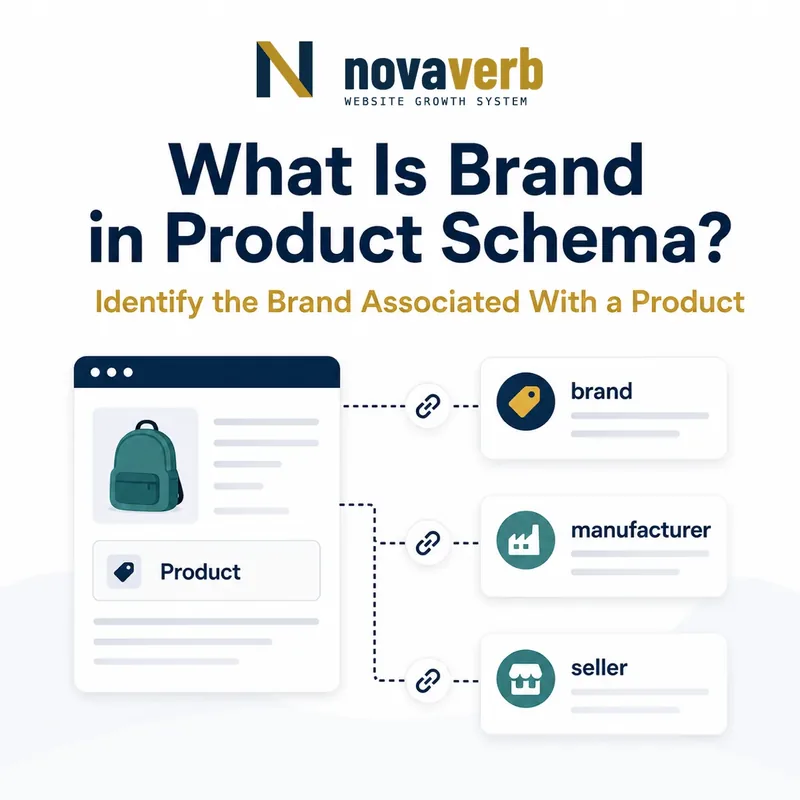
What Is Brand in Product Schema?
Brand in Product schema identifies the commercial brand a product is sold under, normally by placing a Brand object with a clear name inside the Product entity.
This property answers a product identity question, not a store ownership question. A shopper can buy the same branded item from several sellers, while the brand remains stable. That distinction lets product data, page copy and structured data describe the same entity without treating every merchant as the product's brand.
- Identify the exact page, asset, entity or relationship described in this section.
- Inspect the live implementation and retain the observed evidence.
- Compare the observation with the intended meaning and its primary specification.
- Correct any mismatch, then retest the live result.
- Record the accountable owner and review date.
| Entity | What it identifies | Typical value |
|---|---|---|
| Product | The item being described | Model or product name |
| Brand | The commercial identity on the item | Brand name |
| Offer | A purchasable listing | Price, currency and availability |
| Seller | The party making the offer | Store or merchant |
- Use the brand customers see on the product and packaging.
- Keep the same spelling across visible copy and structured data.
- Connect identity fields such as GTIN, MPN and SKU only when they are factual.
Teams can inspect the wider implementation with the free backlink checker and Novaverb's product-focused audit workflow.
Primary specification: Schema.org definition for brand.
Brand markup is useful when it preserves the product's real commercial identity across the page, catalog and structured data.
Why Does Brand Matter for Ecommerce SEO?
Brand matters because it gives search systems a consistent identity signal that can be compared with the product name, identifiers, offers and variant relationships.
Brand alone does not guarantee a rich result or a ranking gain. Its practical value comes from reducing ambiguity. When a page calls an item one brand, the feed calls it another and JSON-LD omits the brand entirely, systems must reconcile conflicting records. A consistent brand field makes the product graph easier to understand and maintain.
- The exact page, asset, entity or relationship covered by this section
- The live implementation rather than an editor-only preview
- The primary specification or first-party record defining the expected behavior
- The validation result, accountable owner and review date
| Situation | Risk | Better action |
|---|---|---|
| Brand missing | Identity is less complete | Add it when the page provides evidence |
| Brand conflicts | Catalog records may diverge | Choose one canonical commercial name |
| Seller used as brand | Merchant and product identity blur | Model each entity separately |
| Variant brands differ | Inheritance can become false | Validate every child product |
- Read the visible product title, specifications and packaging evidence.
- Compare the page with the catalog and merchant feed.
- Resolve contradictions before changing JSON-LD.
- Revalidate the rendered page after deployment.
Brand is therefore a data-quality field first and a search feature input second.
A reliable brand property strengthens ecommerce SEO by making the product entity more consistent, not by acting as a standalone shortcut.
How Is Brand Different From Seller and Manufacturer?
Brand is the identity marketed on the product, seller is the merchant offering it, and manufacturer is the organization that made it; one company may fill several roles, but the roles are not interchangeable.
A marketplace page makes the distinction obvious: the product can retain one brand while different merchants publish separate offers. Private-label arrangements can be less obvious because a retailer may own the brand and sell the item. Even then, the structured data should express each role according to what is true rather than copying one organization into every property.
- Identify the exact page, asset, entity or relationship described in this section.
- Inspect the live implementation and retain the observed evidence.
- Compare the observation with the intended meaning and its primary specification.
- Correct any mismatch, then retest the live result.
- Record the accountable owner and review date.
| Role | Question answered | Where it belongs |
|---|---|---|
| Brand | What name is this product sold under? | Product.brand |
| Seller | Who makes this offer? | Offer.seller |
| Manufacturer | Who made the product? | Product.manufacturer |
| Publisher | Who published the page? | Page or site entity |
- Do not infer a manufacturer from a domain name.
- Do not use a marketplace as the brand of every listed product.
- Use an Organization entity for the business role it actually performs.
- Keep Offer data attached to the purchasable listing.
The correct model can contain the same organization in two roles, but only when page and catalog evidence support both.
Separating brand, seller and manufacturer prevents convenient assumptions from becoming structured-data facts.
Which Brand Properties Should Product Markup Use?
Most Product markup needs a Brand object with an accurate name; add an identifier or URL only when it is stable, public and consistently connected to that same brand entity.
A short object is often stronger than an elaborate but unreliable one. The name should match the commercial identity shown to shoppers. An internal database key has little public meaning, and a URL should not be invented merely to make the object look complete. If the site maintains a canonical brand page, a stable identifier can help connect repeated references.
- The exact page, asset, entity or relationship covered by this section
- The live implementation rather than an editor-only preview
- The primary specification or first-party record defining the expected behavior
- The validation result, accountable owner and review date
| Property | Use | Decision rule |
|---|---|---|
| @type | Declares Brand | Use Brand for the product's brand entity |
| name | Human-readable identity | Use the visible canonical brand name |
| @id | Connects repeated references | Use only a stable canonical identifier |
| url | Points to a brand resource | Add only when a genuine page exists |
- Confirm the brand from first-party catalog evidence.
- Normalize spacing, capitalization and legal suffix handling.
- Create one stable brand identity policy.
- Render the JSON-LD and inspect the final HTML.
- Monitor later catalog edits for drift.
A minimal example is "brand":{"@type":"Brand","name":"Example Brand"}, embedded in the relevant Product entity.
Use the smallest truthful Brand object that stays consistent everywhere the product appears.
Can a Product Have More Than One Brand?
A product can be associated with co-branding in the real world, but merchant Product markup should normally choose the single primary brand name that best identifies the item.
Adding several brand values may appear comprehensive, yet it can make catalog matching less predictable and conflict with merchant listing expectations. A collaboration name printed as one combined commercial identity may be represented as that exact primary name. Supporting participants can remain in visible content or other appropriate entity relationships without turning the brand field into a list of every organization involved.
- Identify the exact page, asset, entity or relationship described in this section.
- Inspect the live implementation and retain the observed evidence.
- Compare the observation with the intended meaning and its primary specification.
- Correct any mismatch, then retest the live result.
- Record the accountable owner and review date.
| Case | Primary brand choice | Reason |
|---|---|---|
| Ordinary branded item | The brand on the product | Clear single identity |
| Retailer resale | Original product brand | Seller is not automatically brand |
| Named collaboration | Canonical collaboration name | Matches shopper-facing identity |
| Accessory compatible with a brand | Accessory's own brand | Compatibility does not transfer brand |
- Never use a compatibility brand as the accessory's brand.
- Do not add distributors merely because they appear in procurement data.
- Document the rule for collaborations before bulk generation.
- Escalate ambiguous products for merchandising review.
The goal is not to encode every commercial relationship; it is to identify the product accurately.
When several names appear, select the one primary commercial brand supported by the product page and catalog.
How Should Brand Work With Product Variants?
Product variants should inherit a brand only when every child is genuinely sold under that brand; otherwise each variant needs its own accurate brand value and separate identity.
Color and size variants usually share a brand, while bundles, marketplace selections and customizable products can break that assumption. The parent group can organize related choices, but each purchasable child still needs facts that match its own landing page and identifiers. Brand should never be inherited merely because a template makes inheritance convenient.
- The exact page, asset, entity or relationship covered by this section
- The live implementation rather than an editor-only preview
- The primary specification or first-party record defining the expected behavior
- The validation result, accountable owner and review date
| Variant pattern | Brand handling | Validation |
|---|---|---|
| Size or color | Usually shared | Compare all child records |
| Bundle | Review the bundle identity | Do not copy a component brand blindly |
| Marketplace option | Keep product brand stable | Separate seller offers |
| White-label option | May differ by child | Use the rendered variant evidence |
- Map the parent and child catalog records.
- Identify which attributes change across children.
- Test whether brand is truly invariant.
- Apply inheritance only to the verified set.
- Audit new variants before they enter the group.
See Product variant schema for the wider parent-child model and URL decisions.
Variant inheritance is safe only after the catalog proves that brand does not change between children.
How Do Private Label and Co-Branded Products Work?
Private-label products use the customer-facing private brand, while co-branded products use the canonical commercial identity shown for that specific item rather than an improvised list of corporate participants.
The factory, importer, retailer and trademark owner may all be different organizations. Product markup does not need to expose confidential supply-chain structure, and it must not guess at it. It should reflect the identity supported by the page, packaging and authoritative internal catalog. If merchandising cannot name the product's brand confidently, the structured-data problem begins upstream.
- Identify the exact page, asset, entity or relationship described in this section.
- Inspect the live implementation and retain the observed evidence.
- Compare the observation with the intended meaning and its primary specification.
- Correct any mismatch, then retest the live result.
- Record the accountable owner and review date.
| Business model | Brand value | Avoid |
|---|---|---|
| Private label | Private brand on the item | Substituting the unknown factory |
| Exclusive retailer line | Line's shopper-facing brand | Using store name without evidence |
| Co-branded release | Official product identity | Multiple inconsistent spellings |
| Unbranded commodity | Omit when no brand exists | Inventing “Generic” as a brand |
- Create a controlled catalog vocabulary for brand names.
- Store manufacturer separately when known and relevant.
- Keep collaboration naming consistent across titles and feeds.
- Allow a truthful missing value instead of fabricated completeness.
A governance decision recorded once is safer than a different interpretation embedded in every template.
Private-label and co-branded markup should follow the product's public identity while keeping unsupported corporate relationships out.
What Brand Schema Mistakes Are Common?
The most common mistakes are using the seller as the brand, copying a parent brand onto unrelated variants, inventing missing brands and allowing visible content, feeds and JSON-LD to disagree.
Syntax validators cannot decide whether a brand is true. A perfectly valid object can still describe the wrong entity. This is why review must include the rendered page and source catalog rather than stopping when JSON parses. Another frequent problem is emitting a placeholder such as the store name for every product because the database column is empty.
- The exact page, asset, entity or relationship covered by this section
- The live implementation rather than an editor-only preview
- The primary specification or first-party record defining the expected behavior
- The validation result, accountable owner and review date
| Mistake | Why it fails | Fix |
|---|---|---|
| Seller copied to brand | Roles become inaccurate | Map fields independently |
| Brand only in JSON-LD | User-visible evidence is absent | Align with meaningful page content |
| Placeholder brand | Fabricates identity | Leave missing data honest |
| Mixed naming | Fragments catalog identity | Normalize to one canonical spelling |
| Stale inherited value | New variants become wrong | Validate inheritance continuously |
- Separate syntax errors from factual errors.
- Trace each wrong value to its source field.
- Correct the catalog before patching templates.
- Regenerate affected pages and feeds.
- Recrawl a representative sample and edge cases.
When markup is generated from structured catalog data, fixing the upstream mapping prevents the same defect from returning on thousands of URLs.
The durable fix for Brand schema errors is accurate entity mapping at the source, followed by rendered-page verification.