
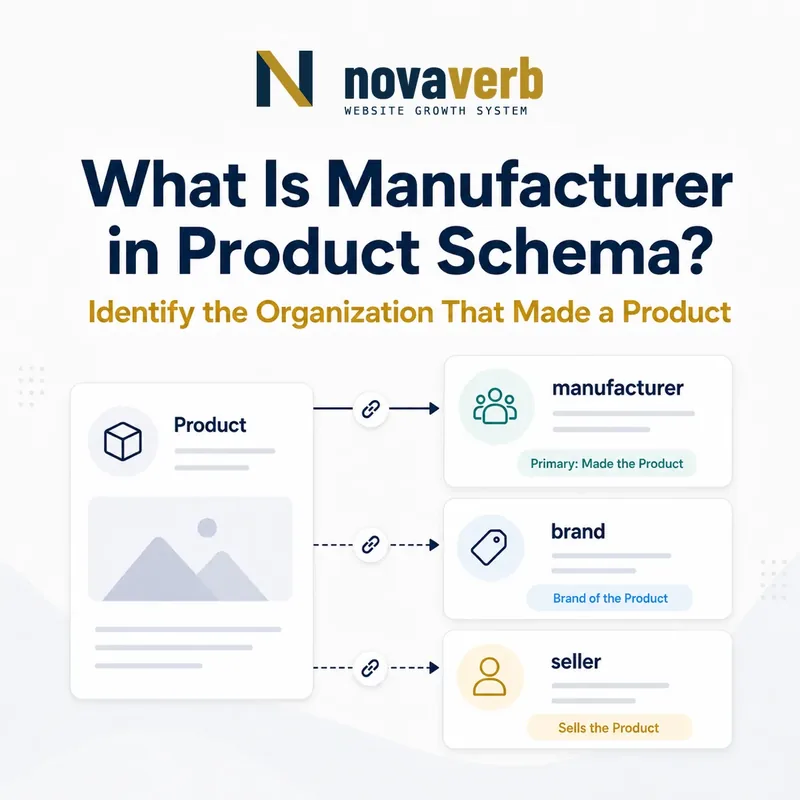
What Is Manufacturer in Product Schema?
Manufacturer in Product schema identifies the organization that physically makes or produces the product, when that fact is known and supported by the page or authoritative catalog data.
The property describes a production role, not the company that owns the website, markets the product, imports it or accepts payment. Those organizations can be the same business, but structured data should not assume they are. A correct manufacturer value helps keep the product entity aligned with specifications, identifiers, brand data and supply-chain records.
- Identify the exact page, asset, entity or relationship described in this section.
- Inspect the live implementation and retain the observed evidence.
- Compare the observation with the intended meaning and its primary specification.
- Correct any mismatch, then retest the live result.
- Record the accountable owner and review date.
| Entity | Role | Typical evidence |
|---|---|---|
| Product | The item described | Product page and catalog |
| Manufacturer | Organization that made it | Packaging, specification or verified record |
| Brand | Commercial identity | Visible brand name |
| Seller | Party offering it | Offer and merchant terms |
- Declare the manufacturer only when evidence supports the relationship.
- Model the organization with a clear canonical name.
- Keep brand, seller and manufacturer as separate roles.
Use the free backlink checker to inspect links reaching important product pages while auditing their product data.
Primary specification: Schema.org definition for manufacturer.
Manufacturer markup is accurate only when it identifies the real producer without borrowing another organization's role.
Why Does Manufacturer Matter for Ecommerce SEO?
Manufacturer matters because it adds a precise organizational relationship to a Product entity and can help reconcile specifications, model numbers, variants and other catalog records.
It is not a guaranteed ranking factor or rich-result trigger by itself. Its value is better understood as entity clarity. When the visible page names one maker, an internal feed names another and structured data copies the merchant, the product record becomes harder to trust. Consistent manufacturer data reduces that ambiguity and gives technical teams a stable field to validate.
- The exact page, asset, entity or relationship covered by this section
- The live implementation rather than an editor-only preview
- The primary specification or first-party record defining the expected behavior
- The validation result, accountable owner and review date
| Condition | SEO and data risk | Response |
|---|---|---|
| Verified manufacturer present | Low identity ambiguity | Keep sources synchronized |
| Manufacturer missing | Relationship is incomplete | Add only if verified |
| Merchant copied as maker | False organizational claim | Correct the source mapping |
| Names conflict | Catalog entities fragment | Resolve ownership and canonical naming |
- Confirm the role from first-party product evidence.
- Compare the page, catalog and rendered JSON-LD.
- Separate factual conflicts from formatting differences.
- Fix the authoritative source before regenerating output.
Coverage should never be increased by filling unknown records with the store name or a guessed supplier.
Manufacturer improves product data when it adds verified clarity, not when it merely increases the number of populated fields.
How Is Manufacturer Different From Brand and Seller?
Manufacturer makes the item, brand is the identity used to market it, and seller creates the purchasable offer; one company may perform multiple roles, but each property answers a different question.
A retailer may sell a branded appliance made by another company. A private-label retailer may own the brand while a contract factory produces the item. A manufacturer may also operate a direct-to-consumer store. The business arrangement determines whether names repeat across properties; the page domain does not.
- Identify the exact page, asset, entity or relationship described in this section.
- Inspect the live implementation and retain the observed evidence.
- Compare the observation with the intended meaning and its primary specification.
- Correct any mismatch, then retest the live result.
- Record the accountable owner and review date.
| Property | Question | Common error |
|---|---|---|
| manufacturer | Who made the product? | Using distributor or importer |
| brand | What identity is it sold under? | Using the marketplace name |
| seller | Who makes the offer? | Using the manufacturer automatically |
| offers | How can it be purchased? | Mixing identity with price data |
- Map every role independently in the product data layer.
- Let the same organization appear twice only when both relationships are true.
- Keep seller details inside the relevant Offer schema.
- Use an Organization entity with a stable name.
This separation also prevents marketplace templates from assigning the marketplace itself as the maker of every listed item.
Role-based modeling keeps manufacturer, brand and seller accurate even when the same company occupies more than one role.
Which Manufacturer Properties Should Product Markup Use?
Product markup should normally represent manufacturer as an Organization with an accurate name, adding a stable identifier or URL only when those values genuinely identify that organization.
A small, reliable Organization object is stronger than a large object assembled from uncertain business directories. The name should come from product evidence or a governed internal record. An @id can connect the manufacturer to another reference on the site, but only if that identifier remains canonical across templates and releases.
- The exact page, asset, entity or relationship covered by this section
- The live implementation rather than an editor-only preview
- The primary specification or first-party record defining the expected behavior
- The validation result, accountable owner and review date
| Property | Purpose | Use rule |
|---|---|---|
| @type | Defines the entity type | Use Organization for the maker |
| name | Names the organization | Use the verified canonical name |
| @id | Connects repeated references | Use only a permanent identifier |
| url | Points to an organization resource | Add only a meaningful, stable page |
- Select the manufacturer from the governed catalog field.
- Normalize spacing and legal-name conventions.
- Create one stable entity identifier policy.
- Embed the object in the correct Product schema.
- Inspect the final rendered HTML.
A concise pattern is "manufacturer":{"@type":"Organization","name":"Example Manufacturing Co."}. Never invent a URL, logo or identifier to make the object appear richer.
The best manufacturer object is the smallest complete representation that the business can consistently prove and maintain.
When Should Manufacturer Be Omitted?
Manufacturer should be omitted when the producer is unknown, confidential, disputed or unsupported by customer-visible and authoritative internal evidence.
Structured data does not need every possible field to be useful. An honest absence is preferable to a fabricated relationship. This is particularly important for marketplaces, vintage items, handmade goods, generic commodities and private-label catalogs where procurement systems may list a vendor that is not the actual factory.
- Identify the exact page, asset, entity or relationship described in this section.
- Inspect the live implementation and retain the observed evidence.
- Compare the observation with the intended meaning and its primary specification.
- Correct any mismatch, then retest the live result.
- Record the accountable owner and review date.
| Situation | Decision | Reason |
|---|---|---|
| Verified maker | Include | Relationship is supported |
| Only seller known | Omit manufacturer | Seller does not prove production |
| Confidential factory | Omit | Do not expose or guess |
| Conflicting records | Investigate first | One source may be stale |
| Handmade by named creator | Model carefully | Confirm the actual entity type and role |
- Do not use “Unknown,” “Generic” or “N/A” as organization names.
- Do not promote a wholesaler to manufacturer without evidence.
- Do not copy the site's Organization entity as a default.
- Record why the field is absent so later imports do not refill it incorrectly.
Missing manufacturer data can still become a catalog task, but it should not become a public claim until verified.
Omit manufacturer whenever completeness would require guessing, substitution or disclosure the product evidence cannot support.
How Should Manufacturer Work With Product Identifiers?
Manufacturer should provide organizational context for identifiers such as MPN, while GTIN and SKU retain their own definitions and must never be derived from the manufacturer name.
An MPN is commonly meaningful in relation to the maker that assigned it. A GTIN belongs to a standardized product-identification system, while SKU is usually an internal merchant or catalog key. Placing all three in one Product object is useful only when every value refers to the same exact item or variant.
- The exact page, asset, entity or relationship covered by this section
- The live implementation rather than an editor-only preview
- The primary specification or first-party record defining the expected behavior
- The validation result, accountable owner and review date
| Field | Identity scope | Manufacturer relationship |
|---|---|---|
| MPN | Maker-assigned part or model | Often interpreted with manufacturer |
| GTIN | Standardized trade item | Must match the exact product |
| SKU | Internal catalog item | Can differ by seller or system |
| Product name | Shopper-facing item | Should describe the same entity |
- Identify the exact purchasable product or variant.
- Verify MPN against the maker's catalog record.
- Validate GTIN without calculating or inventing it.
- Keep SKU scoped to the appropriate catalog.
- Reject identifier sets that describe different variants.
Identifiers should reinforce one coherent product entity rather than create the appearance of completeness from mismatched records.
Manufacturer and identifiers work together only when every value points to the same verified product at the same level of variation.
How Do Private Label and Contract Manufacturing Work?
Private-label markup should identify the actual manufacturer only when that producer is known and intended for public disclosure; otherwise the private brand and seller remain separate, truthful entities.
A contract manufacturer can make products for many brands, and the brand owner may intentionally be the only public identity. Procurement records can also name an importer, trading company or vendor rather than the factory. The structured-data layer should follow verified public product facts, not expose confidential relationships or reinterpret operational fields.
- Identify the exact page, asset, entity or relationship described in this section.
- Inspect the live implementation and retain the observed evidence.
- Compare the observation with the intended meaning and its primary specification.
- Correct any mismatch, then retest the live result.
- Record the accountable owner and review date.
| Model | Manufacturer handling | Brand handling |
|---|---|---|
| Private label, maker disclosed | Use verified maker | Use private brand |
| Private label, maker confidential | Omit | Use verified private brand |
| Contract maker owns brand | May repeat organization | Confirm both roles |
| Importer-only record | Do not treat as maker | Use product's actual brand |
- Label source fields as factory, vendor, importer, distributor and brand owner.
- Create a disclosure rule with merchandising and legal owners.
- Prevent confidential supplier names from reaching public JSON-LD.
- Prefer a truthful omission when supply-chain roles remain uncertain.
The correct output can contain a brand without a manufacturer. Those fields describe different relationships and do not have to be populated together.
Private-label implementation must protect confidential supply-chain data while keeping every public organizational relationship accurate.
How Should Manufacturer Work Across Product Variants?
Variants may share a manufacturer only when the same organization actually produces every child product; inheritance must stop when bundles, licensees, regions or production arrangements change.
Simple size and color variants often retain one maker, but catalogs can group products more broadly than structured data should. A regional version might be produced by a licensee, a bundle can combine several makers, and a marketplace selector can connect offers rather than true variants. Each child must remain factually valid after inheritance.
- The exact page, asset, entity or relationship covered by this section
- The live implementation rather than an editor-only preview
- The primary specification or first-party record defining the expected behavior
- The validation result, accountable owner and review date
| Variant case | Likely handling | Required check |
|---|---|---|
| Size or color | Often shared | Confirm all child records |
| Regional licensee | May differ | Check market-specific maker |
| Multi-item bundle | Avoid blind inheritance | Review bundle identity |
| Marketplace selection | Separate product from offer | Confirm it is a real variant group |
- Map the parent and every purchasable child.
- List attributes that vary across the group.
- Test manufacturer as an independent field.
- Apply inheritance only to the verified subset.
- Monitor newly added children for exceptions.
The broader grouping model is covered in Product variant schema. Manufacturer should follow the child product, not template convenience.
Variant-level manufacturer data is safe only after the catalog proves that the production relationship remains true for every child.